

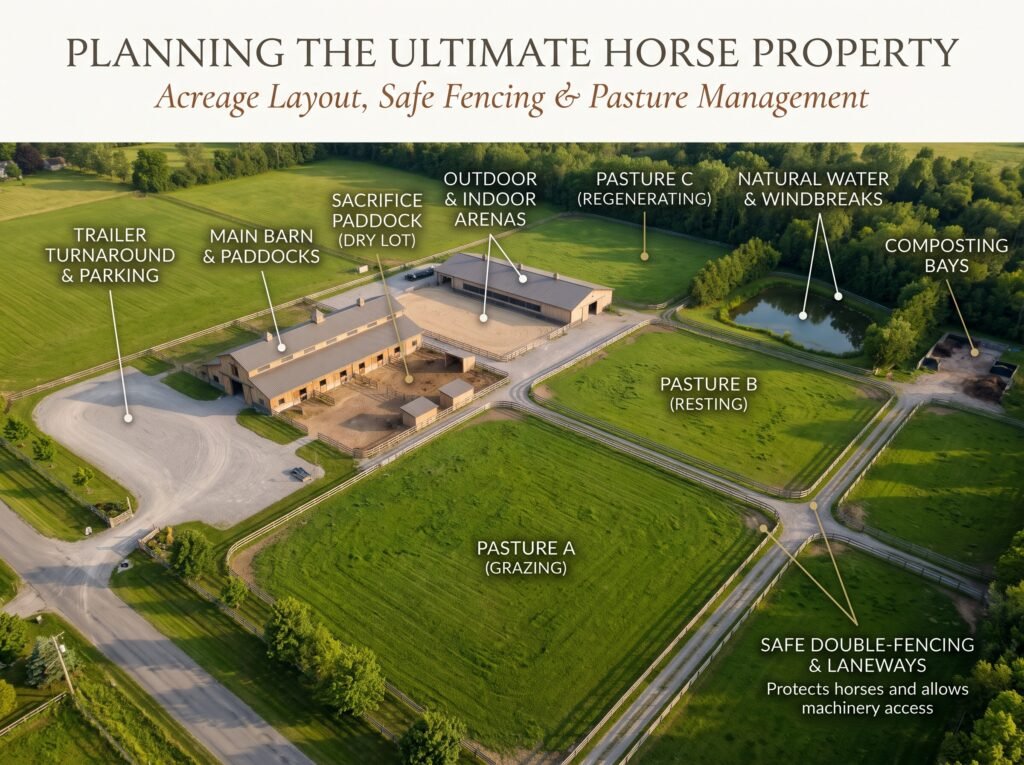
Transforming raw acreage into a thriving, safe, and visually captivating equestrian estate is one of the most rewarding endeavors in the equestrian lifestyle. However, poor property planning leads to mud bogs, ruined pastures, continuous repair expenses, and catastrophic equine fencing injuries. Designing an exceptional horse farm requires an authoritative horse property layout guide that harmonizes civil drainage engineering, agricultural pasture agronomy, equine herd psychology, and daily barn operational ergonomics.
Whether acquiring a boutique five-acre property or establishing a fifty-acre commercial training farm, strategic zoning is everything. In this comprehensive master planning blueprint, we analyze perimeter fencing safety ratings, sacrificial dry lot design, all-weather arena construction, pasture rotation calculations, manure management logistics, and bio-retention stormwater engineering.
Table of Contents
1. Acreage Analysis and Topographical Zoning
Master planning begins with topographical mapping and spatial relationship zoning:
- The Rule of Thumb (Acres Per Horse): Agricultural extension guidelines recommend a minimum of 2 acres per horse for full grazing support without overgrazing. On smaller parcels (3 to 5 acres total), acreage must be intensely managed through dry-lot housing, with pasture access restricted to 2 to 4 hours daily.
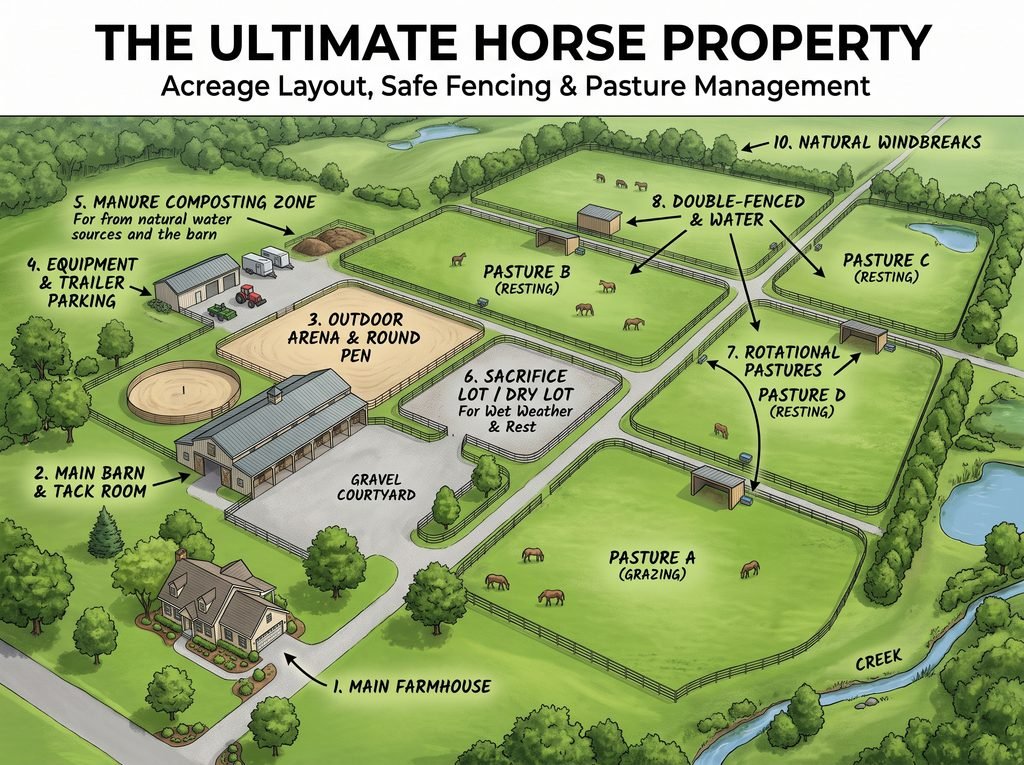
- Hub-and-Spoke Traffic Flow: Position the main barn and sacrifice paddocks centrally as the “hub.” Radiate pastures outward (“spokes”) connected by wide laneways (12 to 16 feet wide). This allows a single handler to turn out or bring in horses effortlessly without walking through intermediate pastures.
- Prevailing Slopes and Setbacks: Place barns, manure storage, and paddocks downwind and downslope from the primary residential dwelling, yet strictly uphill from natural wetlands and property boundaries to prevent runoff contamination.
2. Equine Fencing: Safety Rankings and Materials
Fencing is the single largest capital investment on a horse property—and the primary line of equine defense. Never use barbed wire or loose high-tensile wire, which act as razor-sharp cheese-cutters during flight panic:
| Fencing Material | Safety Rating | Lifespan | Maintenance Level | Aesthetic Appeal |
|---|---|---|---|---|
| Flexible Rail Polymer (Centaur/RAM) | Superior (A+) | 30+ Years | Very Low | High Modern Clean |
| Traditional 4-Board Hardwood | High (A) | 15–20 Years | Moderate (Painting/Rot) | Timeless Luxury |
| Rigid PVC / Vinyl Post-and-Rail | Moderate (B) | 20+ Years | Low (Can shatter in freezing cold) | Prestigious Classic |
| Diamond V-Mesh with Top Board | Superior (A+) | 25+ Years | Low | Excellent (Foal-Proof) |
| Barbed Wire / Field Fence | Dangerous (F) | Variable | High | Sub-standard (Do Not Use) |
Best Practice Recommendation: Combine flexible polymer rails or 4-board hardwood with a single interior strand of electric poly-rope along the top rail. This prevents horses from leaning, chewing (cribbing), or scratching tails against the fence line.
3. The Sacrifice Paddock: Dry-Lot Engineering
The secret to pristine green pastures is having an engineered “sacrifice paddock” (dry lot) where horses are kept during wet weather, winter freezes, and summer drought to prevent hoof pugging from destroying pasture root crowns:
- Layered Geotextile Sub-Base: Excavate topsoil 8 to 10 inches down. Lay non-woven agricultural geotextile fabric directly across the sub-grade. Add 4 to 6 inches of compacted #57 crushed angular stone, followed by 2 to 3 inches of stone dust or washed concrete sand. This layered profile drains rainwater instantly, completely eliminating mud fever and thrush.
- Mud Management Grids: In ultra-high traffic areas (around gates, water troughs, and hay feeders), install interlocking plastic paddock grids (such as EcoGrid or Mud Control Grids) backfilled with crushed pea gravel.
- Footing Depth: Maintain 3 to 4 inches of washed coarse sand. Avoid fine play sand, which blows away in wind and contributes to sand colic when ingested.
4. Pasture Management: Carrying Capacity and Rotation
Executing an effective horse property layout guide requires dividing acreage into a minimum of three or four rotational grazing cells:
- The 3-to-8-Inch Grazing Rule: Turn horses onto pasture when grass swards reach 6 to 8 inches in height. Remove horses to the sacrifice dry lot the moment grass is grazed down to 3 inches. Grazing below 3 inches depletes the plant’s carbohydrate energy reserves stored in the lower stem, causing grass death and weed invasion.
- Mowing and Harrowing: Clip pastures immediately after horses leave to equalize uneven “lawns and roughs” (grazed vs. dunging areas). Only drag pastures to break up manure piles during hot, dry summer periods when fields will rest for 4 to 6 weeks.
- Soil Testing & Overseeding: Test soil pH annually. Maintain soil pH between 6.2 and 6.8 with agricultural lime to optimize nutrient uptake, and broadcast endophyte-free orchard grass and Timothy seed each autumn.
5. All-Weather Riding Arena Construction and Footing
A world-class training arena protects equine joints, tendons, and performance confidence:
- Dimensions: Standard dressage arena requires 20×60 meters (approx. 70×200 feet). A jumping or multi-discipline arena should measure at least 100×200 feet or 150×250 feet for flowing course work.
- Laser-Graded Crowned Sub-Base: Excavate and laser-grade the base with a 1% slope from the center crown out toward French perimeter drains. Compact a 6-inch base of dense crushed limestone until it achieves concrete-like impermeability.
- Synthetic Footing Composition: Top the base with 2.5 to 3 inches of washed sub-angular silica sand blended with polypropylene geotextile felt fibers and synthetic elastic fibers. This creates consistent shear resistance, energy return, and zero dust.
6. Run-In Shed Architecture and Orientation
Pasture shelters provide critical protection against summer insects, solar radiation, and winter blizzards:
- Orientation: Face the open front toward the south or southeast, shielding horses from prevailing north and northwest winter storms.
- Dimensions: Provide at least 100 to 120 square feet per horse (e.g., a 12×24 foot shed comfortably shelters two to three horses). Provide dual wide openings or an open front to prevent a dominant horse from cornering and trapping a herdmate inside.
- Kick Walls: Line internal walls up to 5 feet high with 2-inch-thick rough-sawn oak planks to prevent punctured metal siding from kicking.
7. Manure Management and Composting Systems
An adult horse produces approximately 50 lbs of manure and soiled bedding daily—roughly 9 tons annually:
- The 3-Bin Aerated Composting System: Build three concrete-walled bays: Bin 1 is filling, Bin 2 is actively composting, and Bin 3 is cured compost ready for pasture spreading.
- Thermophilic Heat Inactivation: When properly turned or supplied with forced-air PVC floor pipes, compost piles reach internal temperatures of 130°F to 150°F (55°C to 65°C), completely incinerating parasite eggs, weed seeds, and pathogens within weeks.
- Concrete Pad with Leachate Control: House manure on a poured concrete apron with concrete curbed containment walls to prevent nutrient nitrogen runoff into local groundwater.
8. Water Infrastructure and Freeze-Proof Hydrants
Reliable winter water prevents thousands of dollars in emergency colic veterinary bills:
- Bury Below Local Frost Lines: Water supply lines (1-inch high-density polyethylene HDPE pipe) must be buried at least 12 inches below the local frost depth (typically 3 to 5 feet deep).
- Frost-Free Sanitary Yard Hydrants: Install true frost-free shut-off hydrants that drain water into an underground gravel bed when closed.
- All-Weather Automatic Heated Waterers: Insulated, double-walled poly waterers featuring low-wattage thermostatically controlled electric heating elements guarantee clean 45°F to 50°F water even in -20°F blizzards.
Frequently Asked Questions
What is the safest fencing height for horses?
Perimeter fences should stand 54 to 60 inches (4.5 to 5 feet) high. For stallion paddocks or athletic jumping warmbloods, 66 inches (5.5 feet) provides necessary peace of mind against escape attempts.
How far should trees be planted from horse fences?
Plant shade trees at least 15 to 20 feet outside paddock fence lines. This prevents horses from chewing bark (girdling trees), protects roots from soil compaction, and prevents poisonous leaves (like red maple, black walnut, or cherry) from falling into grazing areas.
Can you spread raw horse manure directly onto active pastures?
No. Spreading fresh, uncomposted manure distributes millions of infective strongyle parasite larvae across the grass. Manure must undergo thermophilic composting for at least 6 to 8 weeks before being spread onto fields.
Conclusion
Executing an intelligent horse property layout guide transforms ordinary countryside land into an equestrian paradise. By investing in safe perimeter fencing, all-weather mud-free dry lots, rotational pasture cells, engineered arena footing, and freeze-proof water systems, you cultivate an estate that delivers supreme equine welfare, effortless daily management, and breathtaking countryside beauty.
