

Introduction
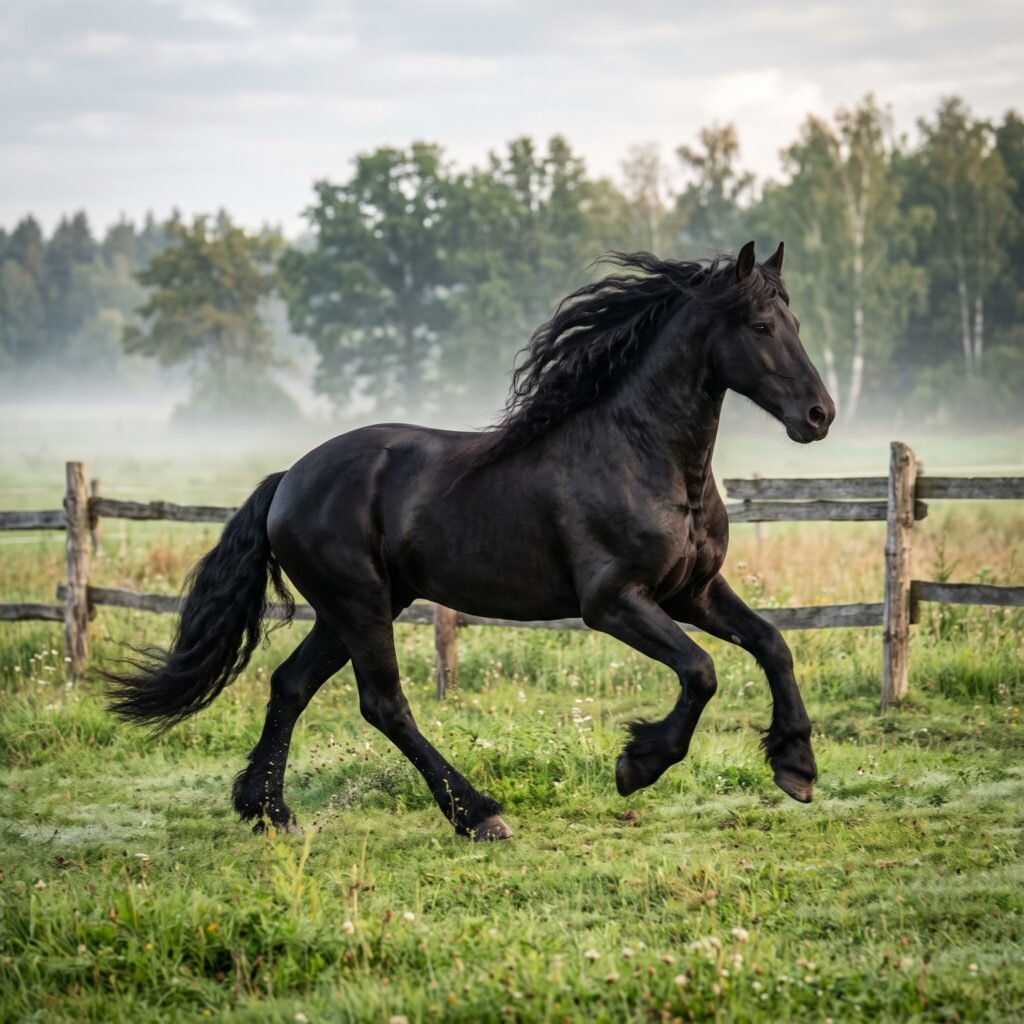
Few horse breeds capture attention quite like the Friesian horse. With its glossy black coat, flowing mane, feathered legs, and powerful movement, this magnificent breed has become one of the most recognizable horses in the world.
Originally developed in the Friesland region of the Netherlands, the Friesian has a long history as a war horse, agricultural worker, and elegant carriage horse. Today, it is admired in dressage, driving competitions, recreational riding, breeding programs, and even the film industry.
Beyond its dramatic appearance, the Friesian is known for its intelligence, friendly personality, and willingness to work. However, owning one requires a good understanding of its grooming needs, nutritional requirements, training, and potential health concerns.
In this complete Friesian horse guide, we explore the breed’s history, physical characteristics, temperament, colors, lifespan, health, daily care, training, and purchase price.
1. Friesian Horse History and Origin
The Friesian horse originated in Friesland, a province in the northern Netherlands. It is considered the only horse breed native to the Netherlands.
Its history extends back to at least the Middle Ages, when strong horses were essential for transportation, agriculture, and military activities.
Medieval War Horses
During the Middle Ages, Friesian horses were valued for their strength and ability to carry heavily armored knights.
Their powerful bodies and impressive presence made them suitable for demanding work, while their distinctive appearance helped establish their reputation throughout Europe.
Historical accounts suggest that horses resembling modern Friesians were used by European military forces and traveling knights.
The Influence of Andalusian Horses
During the sixteenth and seventeenth centuries, Friesian horses were influenced by Spanish and other European bloodlines.
Crossbreeding with Andalusian horses helped introduce qualities associated with a more refined appearance, elevated movement, and carriage-horse elegance.
These influences contributed to the development of the Friesian type recognized today.
From Agricultural Work to Carriage Horses
For centuries, Friesians served as valuable working horses in Dutch agriculture.
They were used for pulling carts, transporting goods, and helping farmers with everyday tasks.
As agricultural machinery became more common, the breed’s traditional working role declined. Dedicated breeders and enthusiasts helped preserve the Friesian through organized breeding programs.
The breed gradually regained popularity as a riding, driving, and show horse.
The Modern Friesian Horse
Today, Friesians are bred and registered internationally, with the main Dutch studbook managed by the Koninklijke Vereniging Het Friesch Paarden-Stamboek (KFPS).
Modern breeding emphasizes a combination of traditional Friesian beauty, functional conformation, healthy movement, and athletic ability.
2. Friesian Horse Characteristics and Appearance
The Friesian is famous for its elegant appearance and distinctive physical features.
It is a medium-to-large horse with a muscular body, high-set neck, expressive head, and abundant hair.
Friesian Horse Physical Characteristics
| Feature | Description |
|---|---|
| Breed Type | Warmblood |
| Country of Origin | Netherlands |
| Original Region | Friesland |
| Typical Height | Approximately 15.2–17 hands, with some individuals taller |
| Average Weight | Often around 1,300 pounds or more |
| Body Structure | Muscular, strong, and harmonious |
| Head | Expressive with large, intelligent eyes |
| Neck | Long, muscular, and elegantly arched |
| Mane and Tail | Thick, long, and often wavy |
| Legs | Strong with distinctive feathering |
| Movement | Elevated, expressive, and powerful |
| Common Color | Black |
1. The Elegant Head and Expressive Eyes
The Friesian has a refined head with an expressive appearance.
Its large eyes, small attentive ears, and elegant facial structure contribute to its distinctive character.
2. The Long, Arched Neck
One of the most recognizable Friesian features is its high-set, muscular neck.
The naturally arched neck creates an impressive silhouette, particularly when the horse is moving or standing in a show presentation.
3. The Powerful Body and Hindquarters
Friesians have strong bodies and muscular hindquarters that help support their movement and pulling ability.
A balanced body structure is important for riding, dressage, and carriage driving.
4. The Famous Feathered Legs
The long hair around the lower legs is known as feathering.
This feature gives the Friesian its traditional appearance, although it requires regular cleaning and inspection to prevent dirt and moisture from accumulating underneath.
3. Friesian Horse Colors and Markings
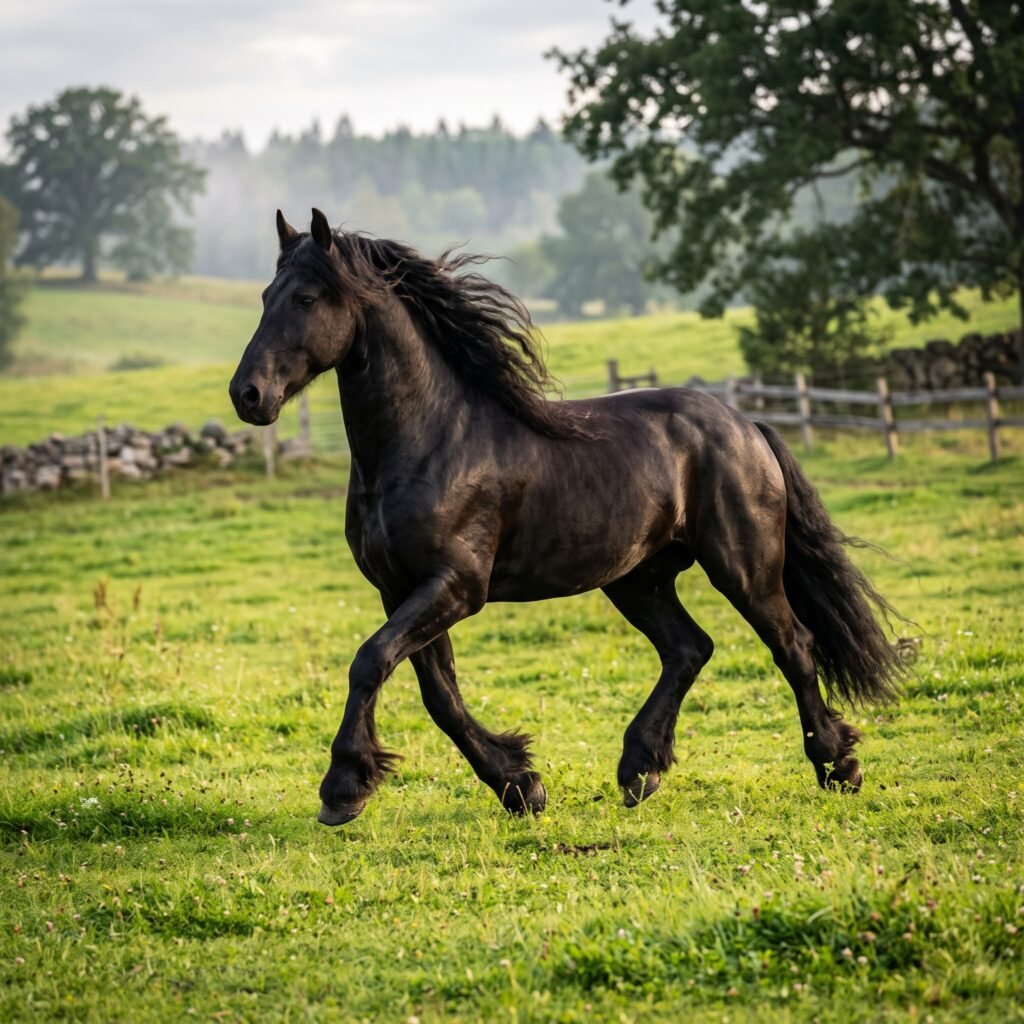
The traditional purebred Friesian is famous for its solid black coat.
Black is the defining color of the modern breed, and the KFPS breeding standard places strong emphasis on maintaining this characteristic.
Common Friesian Coat Colors
| Color | Description | Purebred Status |
|---|---|---|
| Jet Black | Deep, glossy black coat | Traditional and preferred |
| Fading Black | Black coat with brownish or reddish highlights | May occur |
| Black Bay | Very dark coat with subtle brown areas | Not the traditional standard appearance |
| Chestnut | Reddish-brown coat | Rare and associated with specific genetic lines |
Purebred Friesians are generally expected to be black. A small star on the forehead may be permitted under certain registry rules, while larger white markings are generally not accepted.
It is important to distinguish a registered purebred Friesian from a Friesian cross or Friesian Sporthorse, since crossbred horses may have different colors and markings.
4. Friesian Horse Temperament and Personality
The Friesian is admired for its beauty, but its personality is another reason for its popularity.
Many Friesians are described as friendly, intelligent, energetic, and willing to work.
Friendly and People-Oriented
Friesians often enjoy human interaction and can develop strong relationships with their owners and handlers.
With consistent handling, they can become affectionate and dependable companions.
Intelligent and Trainable
Their intelligence and willingness to learn can make training enjoyable.
They often respond well to clear instructions, patient handling, and positive reinforcement.
Energetic but Gentle
Friesians are powerful horses with active personalities. Although many have calm and friendly temperaments, individual behavior varies.
Their size and strength mean that proper training and handling are essential, especially for inexperienced owners.
Are Friesian Horses Suitable for Beginners?
A well-trained Friesian with a suitable temperament may be appropriate for some beginner riders.
However, beginners should consider the horse’s size, strength, training history, and energy level.
Professional instruction and an experienced horse handler are recommended when learning to ride or care for a Friesian.
5. Friesian Horse Uses and Disciplines
Although the Friesian was historically used for warfare and agricultural work, modern horses participate in several equestrian disciplines.
Dressage
Friesians are popular in dressage because of their expressive movement, elevated trot, and impressive presence.
Their natural appearance makes them particularly attractive in traditional and show-oriented dressage presentations.
Carriage Driving
Driving is one of the breed’s traditional strengths.
Their powerful bodies, energetic movement, and elegant appearance make them well suited to pulling carriages in recreational and competitive settings.
Recreational Riding
Many Friesians are used for pleasure riding and trail riding.
A properly trained horse can provide an enjoyable riding experience, provided the workload is appropriate for its physical condition.
Shows and Entertainment
Friesians are frequently seen in exhibitions, breed shows, historical performances, and films.
Their black coats and flowing manes make them especially recognizable on screen.
Common Friesian Horse Disciplines
| Discipline | Suitability |
|---|---|
| Classical Dressage | Very popular |
| Carriage Driving | Excellent traditional use |
| Recreational Riding | Suitable with proper training |
| Trail Riding | Suitable for appropriate horses |
| Breed Shows | Very popular |
| Film and Entertainment | Frequently used |
| High-Level Show Jumping | Not generally a specialized strength |
| Endurance Riding | Not usually the preferred breed |
6. Friesian Horse Training Guide
Friesians are intelligent horses that can learn new skills with consistent and patient training.
However, their size and strength make a proper training foundation especially important.
Start with Basic Groundwork
Before introducing advanced riding exercises, establish good ground manners.
Important foundations include:
- Leading calmly.
- Standing quietly for grooming.
- Accepting handling of the legs and hooves.
- Responding to voice commands.
- Respecting personal space.
- Remaining relaxed during routine care.
Introduce Riding Gradually
Under saddle, begin with simple exercises that improve balance, confidence, and responsiveness.
Training should progress according to the horse’s age, fitness, and experience.
Develop Strength and Flexibility
Regular, progressive exercise helps improve muscle condition and coordination.
A balanced program may include walking, trotting, transitions, bending exercises, and suitable rest periods.
Use Consistent Training Methods
Friesians generally benefit from:
- Clear communication.
- Short, productive training sessions.
- Consistent routines.
- Positive reinforcement.
- Appropriate recovery time.
- Experienced supervision when necessary.
Avoid harsh training methods or increasing workload too quickly.
7. Friesian Horse Grooming and Daily Care
One of the biggest responsibilities of owning a Friesian is maintaining its thick mane, long tail, and feathered legs.
These features are beautiful but require regular attention.
Essential Friesian Grooming Tools
| Grooming Tool | Purpose |
|---|---|
| Rubber Curry Comb | Loosens dirt and dead hair |
| Body Brush | Removes dust from the coat |
| Soft Finishing Brush | Smooths the coat |
| Mane and Tail Comb | Detangles long hair |
| Wide-Tooth Brush | Helps prevent hair breakage |
| Hoof Pick | Removes dirt and stones |
| Soft Sponge | Cleans the face |
| Clean Towels | Dries and finishes the coat |
Daily Coat Grooming
Brush the body regularly to remove dust, loose hair, and dirt.
Pay particular attention to areas where sweat and dirt can accumulate, including underneath the mane and around the saddle area.
Mane and Tail Maintenance
The Friesian’s long mane and tail need gentle handling.
Follow these practices:
- Detangle carefully from the ends upward.
- Use a wide-tooth comb.
- Avoid pulling through knots.
- Use a horse-safe detangling product when necessary.
- Keep the mane and tail clean and dry.
- Braid the hair when appropriate to reduce tangling.
Feathered Leg Care
The feathering around the lower legs is one of the breed’s most recognizable features.
However, excessive moisture and trapped dirt can contribute to skin irritation and infection.
Check the legs regularly for:
- Swelling.
- Scabs.
- Redness.
- Unusual discharge.
- Skin irritation.
- Changes in temperature or sensitivity.
Keep the feathering clean and dry, and seek veterinary advice if skin problems develop.
Hoof Care
Daily hoof cleaning is important for every horse.
Use a hoof pick to remove stones, mud, and debris. Arrange regular visits from a qualified farrier to maintain hoof balance and appropriate trimming.
8. Friesian Horse Nutrition and Feeding Requirements
Friesians need a balanced diet that supports their size, activity level, and overall health.
Some individuals can gain weight easily, so owners should monitor body condition carefully.
Main Nutritional Requirements
| Nutrient or Feed | Common Sources | Purpose |
|---|---|---|
| Forage | Grass hay and suitable pasture | Provides fiber and supports digestive health |
| Protein | Quality forage and balanced feeds | Supports muscle and tissue maintenance |
| Energy | Forage and appropriate concentrates | Supports daily activity and exercise |
| Vitamins | Balanced equine feed | Supports normal body functions |
| Minerals | Equine mineral supplements | Supports bone, muscle, and metabolic health |
| Water | Clean, fresh drinking water | Essential for hydration and digestion |
| Salt | Equine salt supplements | Helps replace sodium and chloride |
How Much Should a Friesian Horse Eat?
A commonly used starting guideline for adult horses is approximately 1.5–2% of body weight in forage daily, measured on a dry-matter basis.
For example, a horse weighing 1,300 pounds may require approximately 19.5–26 pounds of forage dry matter per day.
The actual amount depends on forage quality, pasture intake, workload, body condition, and individual health.
Avoid Overfeeding
Excess calories can contribute to obesity and increase the risk of joint problems and laminitis.
Monitor your horse’s weight and adjust its diet with guidance from an equine veterinarian or nutritionist.
9. Friesian Horse Health Problems and Lifespan
Although Friesians are admired for their strength and beauty, the breed has certain inherited health concerns that prospective owners should understand.
Responsible breeding, genetic testing, and regular veterinary examinations are important parts of long-term care.
Common Health Conditions
| Health Condition | Description | Important Consideration |
|---|---|---|
| Aortic Rupture | A serious condition affecting the aorta | Can be life-threatening and may occur suddenly |
| Hydrocephalus | Abnormal accumulation of fluid in the brain | An inherited condition affecting foals |
| Megaesophagus | Enlargement and reduced function of the esophagus | Can cause swallowing difficulties and aspiration problems |
| Dwarfism | An inherited skeletal development disorder | Genetic testing can help identify carriers |
| Skin Problems | Irritation and infection around the feathered legs | Regular cleaning and inspection are important |
| Obesity | Excessive body fat | Can increase the risk of metabolic and joint problems |
Aortic Rupture
Aortic rupture is a serious condition reported in Friesian horses.
Possible warning signs may include poor performance, abnormal pulse, fever, lameness, or nosebleeds, although some cases occur without obvious warning.
Any concerning symptoms require immediate veterinary attention.
Hydrocephalus
Hydrocephalus is a serious inherited condition involving excessive fluid accumulation in the brain.
Affected foals may have an abnormally enlarged head and severe neurological problems.
Genetic testing can help breeders reduce the risk of passing on the associated mutation.
Megaesophagus
Megaesophagus occurs when the esophagus becomes enlarged and loses some of its ability to move food normally toward the stomach.
Possible symptoms include difficulty swallowing, drooling, weight loss, and choking.
Veterinary diagnosis and an appropriate feeding plan are essential.
Dwarfism
Friesian dwarfism is an inherited condition that affects skeletal development.
Affected horses may have unusually short limbs and abnormal joint structure.
Genetic testing can help identify carriers and support responsible breeding decisions.
How Long Do Friesian Horses Live?
The reported lifespan of Friesian horses varies.
Some sources give a broad range of approximately 16–30 years, but individual lifespan depends on genetics, health, nutrition, workload, and veterinary care.
10. Friesian Horse Price and Buying Guide
Friesian horses are often more expensive than many ordinary riding horses because of their pedigree, distinctive appearance, breeding demand, and specialized training.
The purchase price can vary significantly depending on the horse’s age, registration, bloodline, conformation, and experience.
Average Friesian Horse Price
| Horse Category | Indicative Price Range |
|---|---|
| Young Foal | $5,000–$10,000 |
| Yearling or Young Prospect | $7,000–$15,000 |
| Untrained or Basic Riding Horse | $10,000–$20,000 |
| Trained Riding Horse | $15,000–$30,000 |
| Experienced Show or Driving Horse | $25,000–$50,000+ |
| Exceptional Competition or Breeding Horse | May exceed $50,000 |
These are broad illustrative estimates, not fixed market quotations. Actual prices vary by country, breeder, market conditions, and individual horse quality.
What Affects the Price of a Friesian Horse?
Several factors influence the final purchase price:
1. Pedigree and Bloodline
Horses from respected breeding lines may command higher prices.
2. Age
Young horses may cost less than mature horses with extensive training and competition experience.
3. Training
A horse trained for dressage or carriage driving may be more expensive than an untrained prospect.
4. Registration
Official registration and verified pedigree documents are important when purchasing a purebred Friesian.
5. Health and Conformation
A veterinary examination can help identify potential health problems and assess whether the horse is suitable for its intended purpose.
How to Buy an Authentic Friesian Horse
Before purchasing, ask the seller for:
- Official registration documents.
- Verified pedigree information.
- Microchip identification.
- Veterinary examination records.
- Vaccination and dental history.
- Information about training and previous use.
- Relevant genetic testing information.
For purebred Friesians, buyers should verify registration through the recognized Dutch studbook or its authorized associations.
11. Friesian Horse vs. Other Popular Horse Breeds
The Friesian is sometimes compared with other large, elegant horse breeds.
Understanding their differences can help buyers choose the right horse.
Friesian vs. Andalusian
| Feature | Friesian | Andalusian |
|---|---|---|
| Country | Netherlands | Spain |
| Traditional Color | Black | Commonly grey, bay, or black |
| Mane and Tail | Long and thick | Often thick and flowing |
| Legs | Characteristic feathering | Usually less feathering |
| Movement | Elevated and expressive | Collected and athletic |
| Popular Uses | Driving, dressage, shows | Classical dressage, riding, working equitation |
Friesian vs. Shire Horse
| Feature | Friesian | Shire |
|---|---|---|
| Origin | Netherlands | England |
| Type | Warmblood | Draft horse |
| Main Appearance | Elegant, muscular, high-set neck | Very large, heavy, powerful body |
| Common Colors | Black | Bay, black, grey, and other recognized colors |
| Traditional Uses | Driving, riding, agriculture | Heavy farm work and draft pulling |
Although both breeds can have feathered legs, the Shire is generally much heavier and more specialized for draft work.
12. Is the Friesian Horse Right for You?
The Friesian may be a good choice for someone who appreciates its appearance, enjoys regular grooming, and has the facilities and experience needed to manage a large horse.
Before buying, consider the following:
| Your Requirement | What to Consider |
|---|---|
| Riding | Choose a horse with suitable training and temperament |
| Dressage | Look for balanced movement and appropriate conformation |
| Carriage Driving | Consider experience, fitness, and driving training |
| Grooming | Be prepared to maintain the mane, tail, and feathering |
| Budget | Include veterinary care, feed, farrier visits, and boarding |
| Experience | Seek professional guidance if you are new to large horses |
| Health | Check pedigree, genetic risks, and veterinary records |
The Friesian is not simply a beautiful horse to own. It is a long-term responsibility that requires time, proper care, and a suitable environment.
13. Frequently Asked Questions About Friesian Horses
Are Friesian Horses Always Black?
Purebred Friesians are traditionally black. The recognized breed standard is strict about coat color, although rare chestnut genetics may occur. Crossbred Friesian horses can have a wider range of colors.
Are Friesian Horses Good for Beginners?
Some well-trained Friesians can suit beginner riders, but their size and strength mean that beginners should work with an experienced instructor.
Are Friesian Horses Friendly?
Yes, the breed is generally known for being friendly, intelligent, and people-oriented. However, temperament varies between individual horses.
Can Friesian Horses Jump?
Friesians can jump recreationally and may participate in some jumping activities. However, their build generally makes them less specialized for high-level show jumping than purpose-bred jumping horses.
Are Friesian Horses Good for Dressage?
Yes. Friesians are popular in dressage and are admired for their expressive movement and elevated trot.
Why Do Friesian Horses Have Hair on Their Legs?
The long hair, known as feathering, is a traditional characteristic of the breed. It contributes to the Friesian’s distinctive appearance but requires regular cleaning and skin inspection.
How Much Does a Friesian Horse Cost?
Prices vary widely. A Friesian may cost several thousand dollars, while highly trained horses with exceptional pedigrees can cost considerably more.
Are Friesian Horses Rare?
Friesians are internationally popular but remain a specialized registered breed. Their population is much smaller than that of many common riding horse populations.
What Is the Difference Between a Friesian and a Friesian Sporthorse?
A purebred Friesian is registered under the relevant Friesian studbook requirements. A Friesian Sporthorse is a crossbred horse that combines Friesian blood with other sport-horse breeds under a separate registration system.
14. Friesian Horse Breed Summary
| Feature | Specification |
|---|---|
| Official Breed Name | Friesian Horse |
| Country of Origin | Netherlands |
| Historical Region | Friesland |
| Breed Type | Warmblood |
| Typical Height | Approximately 15.2–17 hands |
| Average Weight | Around 1,300 pounds or more |
| Primary Coat Color | Black |
| Distinctive Features | Long mane, flowing tail, feathered legs, arched neck |
| Temperament | Friendly, intelligent, energetic, and willing |
| Main Disciplines | Dressage, carriage driving, recreational riding, and showing |
| Average Lifespan | Varies; approximately 16–30 years is commonly reported |
| Main Registry | KFPS |
Conclusion: Why the Friesian Horse Remains So Special
The Friesian horse is one of the most striking breeds in the equestrian world. Its Dutch heritage, glossy black coat, flowing mane, feathered legs, and powerful movement make it instantly recognizable.
Yet its appeal goes beyond appearance. The Friesian combines intelligence, strength, and a generally friendly personality with a long history of working alongside people.
Whether used for dressage, carriage driving, recreational riding, or breeding, the Friesian continues to attract horse lovers around the world.
With responsible breeding, proper nutrition, regular grooming, and appropriate veterinary care, this remarkable breed can remain a rewarding companion for many years.
Friesian Horse Society – History of the Friesian
US Equestrian – Friesian Breed Profile
