

Introduction
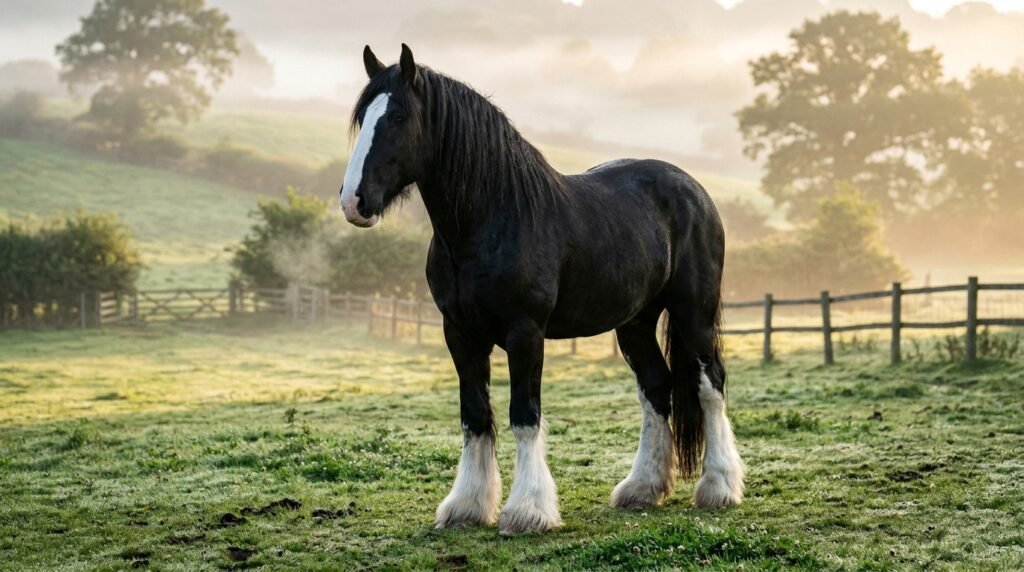
Standing before a mature Shire stallion is an experience that humbles the human spirit. Towering at over six feet at the withers—with ears reaching higher than a basketball rim—and weighing well over a ton (2,200 to 2,600 pounds), the Shire horse is the undisputed colossus of the equine world. Yet, as this mountainous animal lowers its massive, Roman-nosed head to gently nudge your palm with velvet softness, the legend of the “Gentle Giant” instantly transforms from myth into reality.
🐎 Shire Horse Quick Fact Sheet
Originating in the rural heartlands (“Shires”) of central and eastern England, the Shire horse is the direct living descendant of the medieval “English Great Horse” that carried armored knights through Agincourt and Hastings. During the Industrial Revolution, before the invention of diesel combustion engines, hundreds of thousands of these majestic titans powered the British Empire: hauling colossal beer wagons through cobblestone London streets, towing heavily laden coal barges along canals, and clearing ancient oak forests with sheer, unyielding traction.
Despite their historical dominance, the mechanization of modern farming nearly eradicated the breed in the mid-twentieth century, landing them on global endangered livestock lists. Today, preserved through the passion of dedicated breeders, historic British breweries, and draft enthusiasts worldwide, the Shire horse is enjoying a triumphant global renaissance. In this comprehensive breed guide, we uncover the record-breaking history of the breed, the biological mechanics of pulling fifty tons, specialized giant-draft care protocols, and what it truly takes to house, feed, and ride the world’s largest horse.
The Epic Heritage: From Knights’ Chargers to Industrial Titans
The history of the Shire horse mirrors the dramatic transformation of the British landscape over a millennium.
1. The English Great Horse and Royal Decrees
During the twelfth and thirteenth centuries, King John, King Edward II, and later King Henry VIII took direct personal interest in preserving heavy war mounts. Henry VIII passed statutory laws prohibiting the breeding or export of horses under fifteen hands in height, mandating that nobility maintain studs of heavy warhorses (The Great Horse) capable of carrying knights encased in over seventy pounds of plate steel armor into battle.
2. The Dutch Fen Drainage and Flemish Infusion (16th–17th Century)
In the sixteenth century, Dutch engineers arrived in eastern England to drain the swampy Fens of Lincolnshire and Cambridgeshire. They brought massive black draft horses known as the Flemish Horse (Friesian/Belgian ancestor).
These heavy continental stallions were crossed with native English Great Horse mares, imparting:
- Deep, black coat pigmentation.
- Heavy, dense bone density and massive flat cannon bones.
- Abundant, protective white feathering cascading over the lower legs to shield skin from fenland bog waters.
The resulting hybrid was originally christened the “Old English Black Horse”, a direct ancestor codified in 1878 when the English Cart Horse Society (later renamed the Shire Horse Society) was formally established.
World Records: The Colossus of Recorded History
When equestrians debate which breed is the largest in existence, the Shire holds the official Guinness World Record crowns:
+-----------------------------------------------------------------------------------+
|                        THE GREATEST GIANTS IN EQUINE HISTORY                      |
+-----------------------------------------------------------------------------------+
| HORSE NAME            | BREED           | RECORD HEIGHT & WEIGHT                  |
+-----------------------+-----------------+-----------------------------------------+
| Sampson (Mammoth)     | Purebred Shire  | 21.2 Hands (7 ft 2 in / 218 cm) | 3,360 lbs (1,524 kg) |
| Goliath               | Purebred Shire  | 19.1 Hands (6 ft 5 in / 195 cm) | 2,500 lbs (1,134 kg) |
| King LeGear           | Purebred Shire  | 20.2 Hands (6 ft 10 in / 208 cm)| 3,100 lbs (1,406 kg) |
| Big Jake              | Belgian Draft   | 20.2 Hands (6 ft 10 in / 208 cm)| 2,600 lbs (1,179 kg) |
+-----------------------+-----------------+-----------------------------------------+
The Incomparable “Sampson” (Mammoth)
The largest and heaviest horse ever documented in recorded human history was a purebred Shire gelding named Sampson, foaled in 1846 in Bedfordshire, England. Later renamed Mammoth, Sampson stood an unbelievable 21.2 hands high (7 feet, 2.5 inches / 219.7 cm at the withers) and reached an official scale weight of 3,360 pounds (1,524 kg / 1.5 metric tons). To this day, no domestic horse of any breed has ever matched his towering stature.
Defining Breed Characteristics and Conformation Standards
The Shire Horse Society maintains an exacting breed standard that balances gargantuan mass with graceful symmetry:
+-----------------------------------------------------------------------------------+
|                        SHIRE HORSE CONFORMATION SPECIFICATIONS                    |
+-----------------------------------------------------------------------------------+
| ANATOMICAL REGION     | BREED STANDARD REQUIREMENT                                |
+-----------------------+-----------------------------------------------------------+
| Height                | Stallions: Min 17.0+ Hands (Avg 17.2–18.2 hands / 185 cm)|
|                       | Mares: Min 16.1+ Hands (Avg 16.3–17.2 hands)             |
| Weight                | 1,900 to 2,400+ lbs (850 to 1,100+ kg)                   |
| Head Profile          | Long, lean head with distinct convex Roman nose profile   |
| Eyes                  | Large, gentle, docile, and prominent ("sweet eye")        |
| Neck & Shoulder       | Immense, arched, deep crest into deep, sloping shoulders  |
| Chest & Girth         | Barrel-wide chest; heart girth often exceeds 8 feet       |
| Leg Bone Density      | Extremely heavy flat cannon bone (11 to 12.5 inches circ.)|
| Feathering            | Silky, straight, profuse white feather covering hooves    |
| Acceptable Colors     | Black with white markings, Dark Bay, Brown, Grey          |
+-----------------------------------------------------------------------------------+
1. The Head: The Classic Roman Nose
Unlike the dished profile of the Arabian, the Shire exhibits a noble, distinctly convex facial profile (Roman nose). The forehead is broad, leading to large, calm, expressive eyes. The ears are long, lean, and mobile.
2. Massive Bone Density: The Flat Cannon Bone
In equine biomechanics, carrying a ton of body weight requires exceptional skeletal density. The circumference around a Shire’s cannon bone beneath the knee typically measures 11 to 13 inches (28 to 33 cm) of solid, non-porous flat bone. This dense bone structure prevents concussion injuries when working on paved surfaces.
3. The Feather and “Dinner Plate” Hooves
The lower legs feature dense, straight, silky white feathering that flows from the knees and hocks down over the fetlocks. Beneath this hair lie hooves the size of large dinner plates (often requiring size #7 to #9 custom steel horseshoes), providing a wide, stable base of support that distributes immense ground pressure evenly.
Unmatched Pulling Power: Feats of Raw Traction
The pulling capacity of a mature, trained Shire draft team borders on the superhuman:
- The 50-Ton Feat (1924): At the British Empire Exhibition at Wembley in 1924, a pair of working Shire horses pulled an estimated starting load of over 50 tons (100,000 lbs) against a dynanometer—effortlessly moving the maximum registered needle off the scale.
- Traction Over Wheels: A single Shire horse can move a 5-ton wagon from a dead stop on level ground using sheer abdominal leverage, dropping its chest low and driving forward through massive hindquarters.
The “Gentle Giant” Temperament: Docility by Design
When dealing with an animal capable of accidentally crushing human bone with a misplaced step, safety depends entirely on psychology:
+-----------------------------------------------------------------------------------+
|                         THE SHIRE PSYCHOLOGICAL BLUEPRINT                         |
+-----------------------------------------------------------------------------------+
| TRAIT                 | WORKING REALITY IN PRACTICE                               |
+-----------------------+-----------------------------------------------------------+
| Extreme Docility      | Exceptionally low flight response; stops rather than bolts|
| Unshakable Patience   | Stands patiently for hours during shoeing, harnessing     |
| Unconditional Trust   | Highly responsive to soft verbal voice cues ("Whoa", "Gee")|
| Family Safe           | Highly tolerant of children, dogs, machinery, and noise   |
+-----------------------------------------------------------------------------------+
Shire horses are famously phlegmatic, level-headed, and unflappable. Unlike hot-blooded Thoroughbreds that react with explosive flight instincts to startling sounds, a Shire’s natural response to sudden danger is to stop, plant its massive feet, and examine the situation calmly. This extraordinary mental stability makes them safe around novice handlers and children despite their intimidating scale.
Modern Roles: From Brewery Drays to the Dressage Arena
While agricultural plowing is no longer their primary task, Shire horses excel in modern functional roles:
1. Traditional Brewery Drays
Historic British breweries—including Thwaites, Wadworth, and Hook Norton—still maintain active teams of Shire horses that deliver beer wooden casks to local neighborhood pubs daily. This living tradition proves that draft horses remain environmentally sustainable and unmatched in promotional branding power.
2. Sustainable Forestry and Eco-Logging
In fragile nature reserves and steep European woodlands where heavy tractors cause severe soil compaction and destroy root systems, Shire horses are employed for timber extraction (horselogging). They can haul multi-ton logs through dense woods with zero carbon emissions and minimal environmental disturbance.
3. Riding, Trail, and Baroque Dressage
Because of their smooth, rocking-horse canter, Shire horses have become popular riding mounts for adult equestrians seeking a stately, bombproof trail mount. Crosses like the Shire-Thoroughbred produce world-class eventing and fox-hunting mounts with enormous jumping scope.
Giant-Scale Care, Nutrition, and Farriery
Owning a horse that weighs twice as much as a regular riding horse requires specialized facility planning:
1. Gargantuan Nutritional Demands
- Hay Volume: A 2,200-pound Shire consumes roughly 45 to 55 pounds (20 to 25 kg) of quality grass hay daily—equivalent to an entire standard square bale every single day!
- Water Consumption: During hot weather, a single Shire drinks between 25 and 35 gallons (95 to 130 liters) of fresh water daily.
- Forage First: Despite their size, Shires are prone to Equine Polysaccharide Storage Myopathy (EPSM). Their diet should emphasize high-fat, low-sugar forage supplemented with vegetable oils rather than high-starch sweet feed.
2. Barn and Facility Requirements
- Standard 12×12-foot box stalls are too cramped for a Shire. They require custom 14×14-foot or 16×16-foot foaling stalls with reinforced 8-foot-tall wooden walls and heavy-duty iron hardware.
- Horse trailers must have extra-tall (7’6″ to 8’0″ interior clearance) and extra-wide stall widths with heavy-duty ramp ratings.
3. Specialized Farriery and CPL Management
- Finding a farrier experienced with draft horses is essential. Trimming or shoeing a size #8 shoe requires specialized draft hoof stands and physical strength.
- Like Gypsy Vanners, Shires require strict monitoring for Chronic Progressive Lymphedema (CPL) beneath their heavy white leg feathering. Keeping legs dry and treating feather regularly with pig oil and sulfur prevents mite infestations and secondary bacterial dermatitis.
The Shire Marketplace: Pricing and Acquisition Realities
The Shire remains an endangered, vulnerable breed monitored closely by the Rare Breeds Survival Trust (RBST):
| Category | Price Range | Notes & Expected Training |
|---|---|---|
| Weanling / Yearling Prospect | $6,000 – $12,000 | Purebred registered stock with foundation bone |
| Broke Riding / Trail Companion | $12,000 – $22,000 | Sound, safe under saddle, calm for amateur riders |
| Trained Harness / Driving Pair | $25,000 – $50,000 | Fully team-trained in commercial double harness |
| Elite Stallion / Show Champion | $30,000 – $75,000+ | Supreme National Champion bloodlines, heavy feather |
Frequently Asked Questions
What is the difference between a Shire horse and a Clydesdale?
While both originated in the British Isles and share heavy feathering:
- Shires are generally taller, wider through the barrel, possess heavier bone density, have more pronounced Roman noses, and are predominantly black or dark bay.
- Clydesdales are slightly lighter, more active in high knee action, have flatter facial profiles, and are famously recognized by their rich bay coats with extensive high white stockings and sabino roaning.
Can an ordinary person ride a Shire horse?
Yes! Their rhythmic, ground-covering walk and smooth canter feel like riding a comfortable, slow-moving sofa. However, riders need extra-wide draft-tree saddles (often 8 to 10-inch gullet widths) and extended girths.
Are Shire horses endangered?
Yes. The Rare Breeds Survival Trust classifies the Shire as “At Risk” / “Vulnerable”, with fewer than 1,500 breeding females registered worldwide. Supporting ethical breeding programs and adopting Shires helps preserve this irreplaceable living monument of agricultural history.
Breed Card Summary
| Feature | Specification |
|---|---|
| Breed Name | Shire Horse (*The English Cart Horse*) |
| Country of Origin | England (The Shires & Fens) |
| Average Height | 16.3 to 18.2+ hands (170 to 188+ cm) |
| Average Weight | 1,900 to 2,400+ lbs (860 to 1,100+ kg) |
| Record Weight | Sampson: 3,360 lbs (1,524 kg) |
| Primary Colors | Jet-Black with white points, Dark Bay, Brown, Grey |
| Key Physical Trait | Convex Roman head, massive bone, dinner-plate hooves |
| Temperament | Cold-blooded, deeply docile, unflappable, affectionate |
| Average Lifespan | 22 to 28 years |

Equestrian Journalist & Equine Welfare Specialist
Sarah Mitchel brings over fifteen years of hands-on equine management, classical dressage training, and veterinary wellness reporting to Horse Silk. Dedicated to promoting ethical horsemanship, pedigree preservation, and science-backed care protocols.

1 thought on “The Shire Horse: The World’s Largest Gentle Giant, Heavy Draft Power, and British Heritage”