

Table of Contents
Introduction
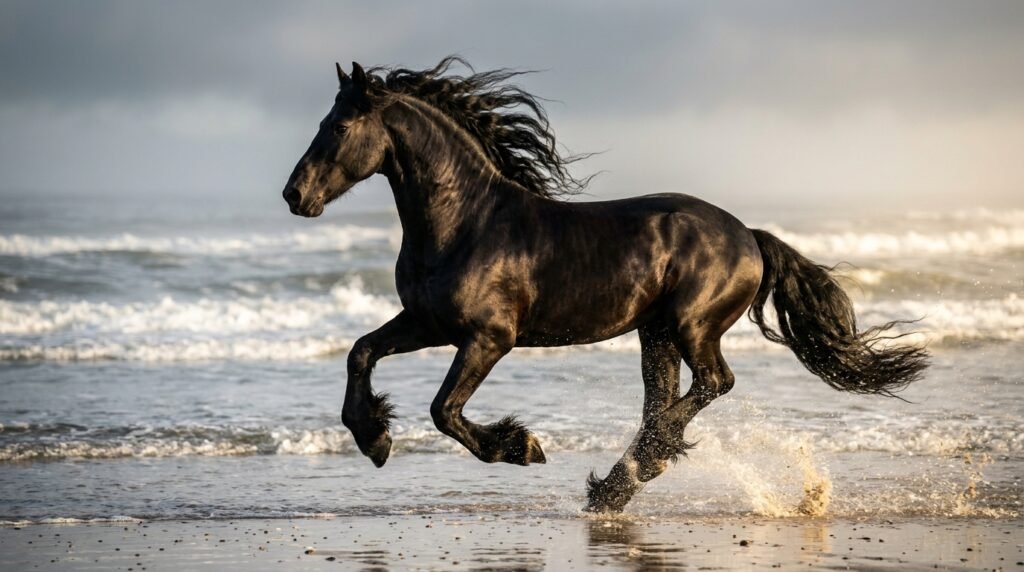
Few sights in the equestrian realm command such breathless awe as a purebred Friesian stallion in full, unrestrained motion. With a coat as lustrous and deep as polished black obsidian, a crest that arches with medieval majesty, and an immense, wavy mane and tail that billow like dark storm clouds in the wind, the Friesian is the undisputed “Black Pearl” of the horse kingdom. When moving, their high-stepping, elevated trot and ground-covering suspension produce an aura of noble power so intense it seems lifted directly from ancient folklore.
🐎 Friesian Horse Fast Facts: The Black Pearl
Yet, this fairytale appearance belies an extraordinary history of resilience. Originating in the coastal province of Friesland in the northern Netherlands, the Friesian is one of Europe’s oldest native breeds. They carried medieval knights clad in heavy steel armor into crusades, pulled elegant royal carriages through European capitals, and miraculously survived two near-extinction crises in the twentieth century through the fierce dedication of Dutch breeders.
Today, governed by the rigorous standards of the Royal Friesian Horse Studbook (Koninklijke Vereniging “Het Friesch Paarden-Stamboek” or KFPS), the Friesian has transformed into an international superstar. They dominate Hollywood cinema, excel in classical Grand Prix dressage, reign supreme in international combined carriage driving, and serve as devoted, emotionally empathetic family partners. In this definitive guide, we explore the deep origins, uncompromising breed standards, unique genetic traits, healthcare requirements, and market realities of the legendary Friesian horse.
The Historical Crucible: From Medieval War Mount to Near Extinction
The survival of the Friesian horse is a dramatic saga of military glory, aristocratic luxury, and near-catastrophic decline.
1. The Medieval Warhorse of Knights (4th Century – 15th Century)
Historical records mention Friesian troops riding native black horses as early as the Roman occupation of Britain under Emperor Hadrian. During the Middle Ages, the Friesian’s unique blend of strength, agility, and unflappable calm made it the ultimate battle charger (destrier). Unlike slow, plodding agricultural drafts, the Friesian could easily carry a knight in 60 pounds of iron plate armor while executing rapid maneuvers on the battlefield without exhausting its rider.
2. The Spanish Renaissance Influence (16th – 17th Century)
During the Eighty Years’ War when the Netherlands was under Spanish rule, Andalusian stallions were crossed with native Friesian mares. This crossbreeding permanently refined the breed:
- It imparted the elegant, dished convex head profile.
- It created the arched swan neck and high-stepping knee action.
- It softened the heavier draft frame into an athletic, versatile baroque carriage horse.
3. The 1913 Brink of Extinction
With the industrial revolution and the mechanization of agriculture, heavy draft breeds and tractors replaced carriage horses. By 1913, the purebred Friesian population had collapsed to an alarming crisis: only three breeding stallions remained in the entire world (Prins 109, Alva 113, and Friso 117).
Recognizing that their national living heritage was weeks away from disappearing forever, a dedicated group of patriotic Dutch farmers gathered in Friesland to establish preservation protocols. By strictly controlling bloodlines and prioritizing purity, they resurrected the breed from the brink. Today, every registered purebred Friesian on earth traces its direct pedigree back to those three surviving stallion lines.
KFPS Breed Standards: The Rules of Pure Perfection
The KFPS, founded in 1879, maintains what is widely considered the strictest, most demanding studbook inspection system (Keuring) in the global equine industry.
+-----------------------------------------------------------------------------------+
|                           KFPS FRIESIAN CONFORMATION MATRIX                       |
+-----------------------------------------------------------------------------------+
| REGION                | STRICT BREED SPECIFICATION                                |
+-----------------------+-----------------------------------------------------------+
| Coat Color            | Exclusively Jet-Black (Small star <3cm tolerated in mares)|
| Height                | Minimum 15.2 hands (158 cm) for studbook approval         |
| Head & Expression     | Noble, dry, expressive, fine ears pointing inwards        |
| Neck                  | Long, arched crest, set high on chest with clean throat   |
| Mane, Tail & Feather  | Abundant, thick, wavy; never clipped or trimmed           |
| Movement              | Powerful, elevated trot with dramatic knee & hock flexion |
+-----------------------------------------------------------------------------------+
1. The Color Mandate: True Black Only
The Friesian must be strictly black. No white markings are permitted on the body or legs. The sole exception is a tiny white star on the forehead (under 3 centimeters in diameter) permitted in mares and geldings; stallions with any white markings whatsoever are permanently barred from breeding approval.
Genetically, true Friesians are homozygous for the recessive black gene (EE, aa). Although rare chestnut foals (called “Fox Friesians”) can occasionally emerge when both parents carry the hidden red factor (Ee), the KFPS strictly bars chestnut stallions from breeding registration.
2. The Magnificent Hair (*Behang*)
The mane, forelock, tail, and lower-leg feathering are collectively known as the behang (coat luxury). In traditional KFPS culture:
- A Friesian’s mane and tail are never cut, banged, or pulled.
- A mature stallion’s mane frequently reaches past his knees, and tails trail gracefully along the arena floor.
- Dense, silky black feathering covers the fetlocks and coronet band.
3. The Signature High-Stepping Trot
The defining athletic hallmark of the Friesian is its high-stepping, elevated trot:
- The front knee folds tightly and elevates with dramatic upward thrust (kneactie).
- Simultaneously, the powerful hind leg reaches deeply under the body with rapid, powerful hock flexion.
- This creates exceptional natural suspension, making the horse appear to float effortlessly above the ground.
Two Distinct Modern Types: Baroque vs. Modern Sport
To meet diverse equestrian demands, modern breeders cultivate two recognized conformational types within the purebred studbook:
1. The Classical “Baroque” Type
The traditional, heavier Friesian reminiscent of the seventeenth-century carriage horse. Characterized by substantial bone density, wider chests, shorter backs, and heavier musculature. Baroque Friesians are beloved for traditional carriage driving (sjees), historical exhibitions, and classical academic equitation.
2. The “Modern Sport” Type
A lighter, taller, more streamlined athlete bred specifically for modern competitive Grand Prix dressage. Sport-type Friesians possess longer legs, lighter bone, more elastic gaits, and greater endurance, allowing them to compete neck-and-neck against Dutch Warmbloods and Hanoverians in international FEI dressage rings.
Hollywood’s Favorite Stallion: The Cinematic Legend
When Hollywood film directors need a steed that embodies fantasy, villainy, nobility, or magical power, they almost invariably choose a Friesian stallion:
- Ladyhawke (1985): Actor Rutger Hauer rode a magnificent 19-hand Friesian stallion named Goliath, single-handedly introducing the breed to millions of modern American moviegoers.
- The Mask of Zorro (1998): Antonio Banderas’ iconic black steed Tornado was portrayed by champion Friesian stallions.
- The Hunger Games: Friesians pulled the dramatic, fire-drenched tribute chariots through the Capitol arena.
- Clash of the Titans, Alexander, and Game of Thrones: Friesians served as the chosen steeds of kings, warlords, and mythological deities.
Their cinematic dominance stems not only from their striking silhouette, but from their unflappable intelligence. On chaotic film sets filled with pyrotechnics, roaring camera cranes, and flashing swords, Friesians remain remarkably calm, focused on their trainers rather than panicking.
Temperament: Gentle Royalty (*The “Golden” Mind*)
Despite their imposing size and fiery appearance in the show ring, Friesians are celebrated for possessing one of the gentlest, most affectionate temperaments in the equine kingdom:
+-----------------------------------------------------------------------------------+
|                        THE FRIESIAN PSYCHOLOGICAL PROFILE                         |
+-----------------------------------------------------------------------------------+
| TRAIT                 | EQUINE BEHAVIORAL MANIFESTATION                           |
+-----------------------+-----------------------------------------------------------+
| Eager to Please       | Tries intensely to understand commands; thrives on praise |
| Emotional Empathy     | Forms profound personal bonds; sensitive to human mood    |
| Low Flight Panic      | High threshold for spooking; assesses threats calmly      |
| Playful Intelligence  | Enjoys trick training, liberty work, and mental challenges|
+-----------------------------------------------------------------------------------+
They are people-oriented horses that actively seek human interaction, often greeting their caretakers at the stall door like giant, loyal dogs. This gentle nature makes them exceptional mounts for adult amateurs seeking majestic presence without the volatile unpredictability of hot-blooded Thoroughbreds.
Health, Genetics, and Special Care Protocols
Because the modern global Friesian population descended from a remarkably narrow genetic bottleneck in 1913, preserving health through responsible DNA screening is paramount:
1. KFPS Genetic Testing Mandates
Ethical breeders screen breeding stock for four documented recessive genetic mutations:
- Hydrocephalus: A fatal defect where cerebral fluid accumulates in the skull, causing extreme cranial enlargement and stillbirth. A mandatory DNA test has eliminated this from approved stallion rosters.
- Dwarfism: Affected foals exhibit normal torso size but disproportionately short, deformed limbs and broad joints. DNA carrier screening prevents carrier-to-carrier matings.
- Aortic Rupture: Weakening of the main aortic artery near the heart, which can cause sudden fatal hemorrhage in adult horses.
- Retained Placenta: Friesian mares have a statistically higher incidence of retaining the fetal placenta post-foaling (occurring in over 50% of births). Veterinary intervention with oxytocin within two hours of delivery is critical to prevent fatal uterine infection.
2. Mane, Tail, and Skin Management
- Mane and Tail Protection: To prevent hair breakage, never brush a dry, tangled Friesian tail. Wash with hydrating botanical conditioners, apply leave-in silicone serums, and loosely braid the hair in three-strand braids enclosed in protective tail sacks.
- Summer Itch (Sweet Itch / Insect Bite Hypersensitivity): Friesians are prone to severe allergic reactions to Culicoides midge saliva, causing intense itching of the mane and tail dock. Use full-body zebra-striped fly sheets and automatic barn misting systems during peak bug seasons.
The KFPS Grading Hierarchy and Pricing Guide
The KFPS Keuring inspection system awards prestigious titles (predicates) that dictate market value:
| Predicate / Category | Price Range | Requirements & Significance |
|---|---|---|
| **Foal / Unregistered Pet** | $8,000 – $15,000 | Healthy grade Friesian, ideal for pleasure and family trails |
| **Studbook Mare / Gelding (Stb)** | $15,000 – $30,000 | Official KFPS green-paper registered, confirmed riding horse |
| **Ster (Star) Predicate** | $25,000 – $60,000 | Awarded to top 10-15% of horses demonstrating superior conformation and trot |
| **Kroon / Model Mare** | $50,000 – $120,000 | Elite international mares demonstrating exceptional athletic performance |
| **KFPS Approved Breeding Stallion** | $150,000 – $1,000,000+ | Fewer than 100 exist worldwide; passed grueling 70-day Central Testing |
Frequently Asked Questions
Can Friesians live in hot climates?
Yes, but they require careful management. Their dark black coats absorb radiant solar heat rapidly, and their thick manes trap body warmth. In warm regions (such as Texas, Florida, or the Middle East), Friesians must have access to air-conditioned barns, misting fans, and nighttime turn-out to prevent heat exhaustion.
Are Friesians difficult to train for dressage?
Not difficult, but different from warmbloods. Their high neck set and upright shoulder make collected movements like piaffe and passage natural and easy. However, training them to stretch forward and down into the contact (vowarts-abwarts) requires a patient, skilled rider to ensure they do not hollow their backs.
Why are Friesians so expensive compared to other horses?
Strict Dutch studbook registration, rigorous veterinary genetic screenings, mandatory Keuring grading, and high international demand maintain strong residual values. A KFPS-registered horse with blue-and-white official papers represents verified European bloodline perfection.
Breed Card Summary
| Feature | Specification |
|---|---|
| **Breed Name** | Friesian Horse (*Friesch Paard*) |
| **Country of Origin** | Netherlands (Friesland Province) |
| **Official Studbook** | KFPS (Founded 1879) |
| **Average Height** | 15.2 to 17.0 hands (158 to 173 cm) |
| **Average Weight** | 1,200 to 1,600 lbs (550 to 730 kg) |
| **Permitted Color** | Pure Jet-Black (Homozygous EE, aa) |
| **Defining Trait** | Massive wavy mane, high knee action, feathered fetlocks |
| **Average Lifespan** | 22 to 28 years |
Equestrian Journalist & Equine Welfare Specialist
Sarah Mitchel brings over fifteen years of hands-on equine management, classical dressage training, and veterinary wellness reporting to Horse Silk. Dedicated to promoting ethical horsemanship, pedigree preservation, and science-backed care protocols.
📖 Recommended Equestrian Reading & Official References
Deepen your equine mastery with these related guides from Horse Silk and leading equestrian authorities:
- Horse Silk Guide: Top 5 Most Expensive Horse Breeds in the World
- Horse Silk Guide: The Shire Horse: World’s Largest Gentle Giant
- Horse Silk Guide: The Golden Akhal-Teke Horse: Metallic Sheen & Desert Endurance
- Official Authority: Koninklijke Vereniging “Het Friesch Paarden-Stamboek” (KFPS)
- Official Authority: Friesian Horse Association of North America (FHANA)

1 thought on “The Majestic Friesian Horse: The Black Pearl of Friesland, Royal Carriage, and Movie Legend”