

Introduction
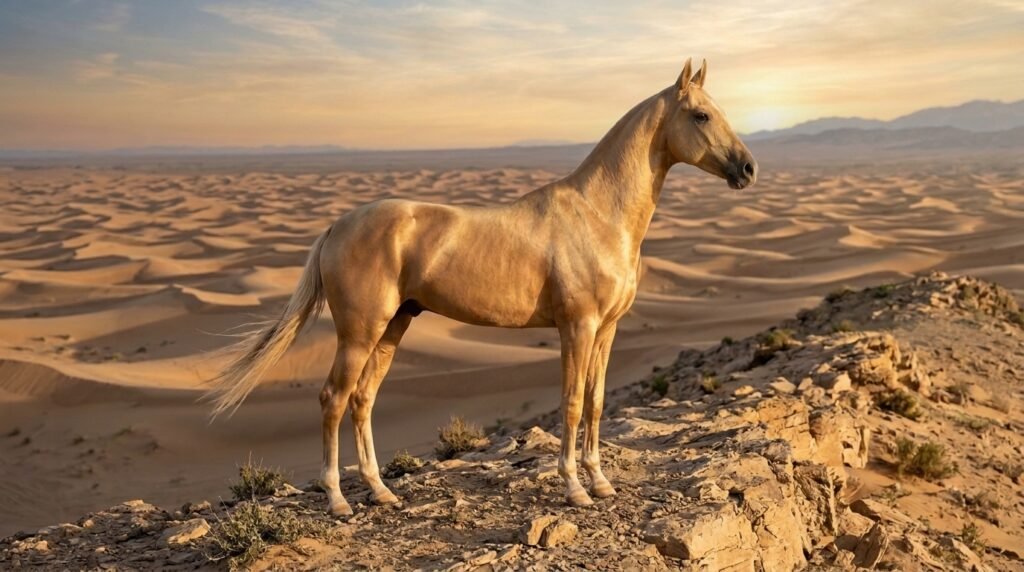
In the entire animal kingdom, few creatures possess an aura so astonishing, rare, and visually surreal as the Akhal-Teke. At first glance, a golden Akhal-Teke in the full radiance of midday sun does not appear to be made of flesh, bone, and hair; rather, it gleams as if sculpted from liquid 24-karat gold or cast in fine polished bronze. Known throughout classical antiquity as the fabled “Heavenly Horses” of Central Asia, for which Chinese emperors launched bloody continental wars, the Akhal-Teke is one of the oldest, purest, and most enigmatic equine breeds in existence.
🐎 Akhal-Teke Horse Quick Fact Sheet
Originating in the harsh, waterless expanses of the Karakum Desert in modern-day Turkmenistan, this breed was engineered not merely for striking aesthetic beauty, but as an extreme-endurance survivalist. With its long, lean, greyhound-like silhouette, hooded almond eyes, high-set swan neck, and legendary heat tolerance, an Akhal-Teke can cover hundreds of miles of blistering sand dunes on meager rations of barley, mutton fat, and alfalfa pellets where other breeds would quickly perish.
Today, with fewer than 7,000 purebred individuals remaining on earth, the Akhal-Teke is rarer than the giant panda or the black rhinoceros. Revered as the national emblem of Turkmenistan—adorning the country’s coat of arms, currency, and postage stamps—this living artifact represents the ultimate crown jewel of equestrian luxury and genetic exclusivity. In this authoritative breed guide, we examine the molecular physics behind their shimmering coats, their legendary 1935 desert endurance march, conformation standards, specialized care, and the realities of modern ownership.
The Ancient Crucible: 3,000 Years in the Karakum Desert
The history of the Akhal-Teke predates modern written European studbooks by thousands of years, tracing its lineage back to the ancient oasis cultures of Central Asia.
The Teke Tribe and the Oasis Environment
The breed derives its name from two roots: “Akhal”, a chain of fertile oases nestled along the northern slopes of the Kopet Dag mountains, and the “Teke”, an ancient, fiercely independent nomadic Turkmen tribe renowned for their equestrian mastery.
Unlike European horses that grazed in lush pastoral herds, the desert climate forced Teke tribesmen to treat their horses as individual family members:
- Horses were kept individually tethered near family yurts.
- They were wrapped in up to seven layers of heavy felt blankets (keche) year-round. In the winter, blankets protected them from freezing Siberian blizzards; in the summer, the blankets acted as insulation against 120°F (49°C) desert heat and prevented sun-bleaching of their precious glossy coats.
- Their diet was compact and dense: balls of kneaded barley flour mixed with sheep tail fat (dumba), fried flatbread, and dried alfalfa. This high-fat, low-bulk diet developed a lean, greyhound-like abdominal profile with exceptional metabolic stamina.
The “Heavenly Horses” and the Han Dynasty War
In 104 BC, Emperor Wu of China’s Han Dynasty sent a military expedition of over 60,000 soldiers across the Taklamakan Desert to the Fergana Valley to acquire these horses. Known as the Tianma (“Heavenly Horses”), they were said to sweat blood (now known to be caused by microscopic skin parasites, Parafilaria multipapillosa, common in the region) and were believed to possess divine celestial speed capable of defeating the nomadic Xiongnu invaders. The resulting “War of the Heavenly Horses” cemented the breed’s status as an imperial asset.
The Optical Physics Behind the Metallic Shimmer
The most celebrated and scientifically intriguing feature of the Akhal-Teke is the metallic iridescence of its coat, especially prominent in palomino, buckskin, perlino, and isabella (cremello) colorations.
+-----------------------------------------------------------------------------------+
|                     THE OPTICAL SCIENCE OF THE AKHAL-TEKE HAIR                    |
+-----------------------------------------------------------------------------------+
| HAIR COMPONENT        | STANDARD HORSE HAIR       | AKHAL-TEKE HAIR               |
+-----------------------+---------------------------+-------------------------------+
| Medulla (Core)        | Thick, dark, opaque core  | Substantially reduced / absent|
| Cortex                | Granular pigment density  | Highly transparent, clear     |
| Cuticle & Shaft       | Circular, light-scattering| Flattened, tube-like prism    |
| Optical Effect        | Normal diffuse reflection | Specular internal refraction  |
+-----------------------------------------------------------------------------------+
How the Hair Acts as a Fiber-Optic Prism
In a standard horse, each individual hair shaft consists of three layers: an outer cuticle, a pigmented cortex, and an opaque central core called the medulla. This dark medulla absorbs light, producing standard matte color reflection.
In the Akhal-Teke, genetic mutation has drastically reduced or eliminated the opaque medulla core. Instead, the cortex is extraordinarily clear and surrounded by a flattened, glass-like cuticle. When sunlight strikes the hair shaft:
- Light penetrates directly into the translucent hair tube.
- The light reflects off the internal surfaces like a fiber-optic cable.
- The light refracts back outward at an angle, intensifying the natural yellow, cream, or chestnut pigment into a blinding, shimmering, metallic gold sheen.
Even solid bay, black, and grey Akhal-Tekes display this phenomenon, exhibiting silvery metallic highlights, glowing mahogany tones, or iridescent gunmetal sheens.
Distinctive Anatomy: The “Greyhound of the Horse World”
The physical conformation of the Akhal-Teke is completely unique among equines. Where warmbloods are round, heavy, and deep-chested, the Akhal-Teke is long, lean, and aerodynamic.
+-----------------------------------------------------------------------------------+
|                        AKHAL-TEKE BREED CONFORMATION MATRIX                       |
+-----------------------------------------------------------------------------------+
| ANATOMICAL REGION     | CHARACTERISTIC STANDARD                                   |
+-----------------------+-----------------------------------------------------------+
| Height                | 14.3 to 16.0 hands (150 to 163 cm)                        |
| Head & Profile        | Lean, dry, straight or slightly convex, hooded eyes       |
| Neck                  | Long, slender, high-set, S-shaped or "stag" neck          |
| Withers & Chest       | High, prominent withers; deep but narrow chest            |
| Body & Ribs           | Long back, light rib cage, tucked greyhound flank         |
| Legs & Hooves         | Extremely lean, dense bone, small hard hooves, no feather |
| Mane & Forelock       | Very sparse, fine, often virtually non-existent           |
+-----------------------------------------------------------------------------------+
1. The Head and Hooded Eyes
The head is long, dry, and chiselled, featuring large nostrils and thin, sensitive lips. The eyes are distinctively hooded or almond-shaped, often angled slightly upward. This structural eyelid adaptation shields the sensitive cornea from stinging desert sandstorms and blinding sun reflection off the dunes.
2. The High-Set Neck and Slender Frame
The neck is long, thin, and set high onto the chest at an upright angle (often around 45 to 50 degrees). While dressage purists accustomed to thick warmblood crests sometimes critique the lean neck as a “stag neck,” in desert travel this high head carriage allows the horse to survey distant horizons and breathe freely while galloping.
3. Sparse Mane and Tail
Unlike the lavish manes of Friesians or Gypsy Vanners, the Akhal-Teke possesses a naturally sparse, silky mane and tail, often lacking a forelock entirely. In an arid desert climate with 120°F temperatures, heavy hair traps lethal heat and accumulates sand burrs; evolution selected for minimal, razor-fine hair.
Athletic Feats: The Legendary 1935 Desert March
The physical endurance and psychological resilience of the Akhal-Teke are not theoretical; they are proven through historical athletic feats that remain unmatched in equestrian history.
In 1935, to test the breed’s stamina against modern military cavalry standards, a squad of Turkmen riders rode 30 Akhal-Teke horses from Ashgabat to Moscow:
- Total Distance: 2,670 miles (4,300 kilometers).
- Time Elapsed: Exactly 84 days.
- The Karakum Crossing: The most grueling segment traversed 225 miles of completely waterless, trackless sand dunes across the Karakum Desert in scorching heat.
- The Result: The horses crossed the 225 miles in just three days, receiving zero water. Every single one of the 30 Akhal-Teke horses arrived in Moscow healthy and fully sound, proving their physiological superiority over all competing European cavalry breeds.
Modern Olympic Success: Absent
In 1960 at the Rome Olympic Games, a magnificent black Akhal-Teke stallion named Absent, ridden by Soviet equestrian Sergei Filatov, captured the Individual Gold Medal in Grand Prix Dressage. Absent returned to win Bronze in Tokyo (1964) and Team Silver in Mexico City (1968), proving that the breed possesses classical European collection alongside desert speed.
Temperament: The “One-Rider” Phenomenon
The psychological makeup of the Akhal-Teke is legendary among professional trainers:
- The One-Master Bond: Because Bedouin and Teke nomads hand-raised foals alongside their families, the breed developed a fiercely loyal, single-person bonding instinct. An Akhal-Teke will bond passionately with its primary caretaker, reading subtle shifts in body language, vocal tone, and emotion.
- Sensitivity to Injustice: They possess extraordinary pride and emotional memory. If treated with brutality, harsh spurring, or unjust punishment, an Akhal-Teke will not submit; it will defensively resist, shut down, or become dangerous.
- Cat-Like Agility: In motion, their gaits are remarkably smooth, elastic, and free of vertical jarring. The trot and canter glide effortlessly over terrain, earning the gait description “swimming over the ground.”
Care, Nutrition, and Health Considerations
Because of their unique desert genetics, caring for an Akhal-Teke requires specific attention to diet and climate adaptation:
1. Metabolic Feeding Guidelines
- Avoid Heavy Starch and High-Sugar Diets: Akhal-Tekes evolved on sparse forage and high-fat protein supplements. High-sugar grain concentrates or rich clover pasture easily cause metabolic founder and digestive upset.
- High-Quality Grass Hay: Feed quality timothy, teff, or orchard grass hay. Supplement with vegetable oil or stabilized rice bran for cool, concentrated caloric fat.
2. Genetic Health: Naked Foal Syndrome (NFS)
The breed carries a specific, fatal monogenic autosomal recessive condition known as Naked Foal Syndrome (NFS):
- Affected foals are born completely hairless (alopecia), with severe tooth malformations, digestion defects, and fragile skin.
- NFS foals rarely survive past several weeks of age.
- Genetic Prevention: A commercial DNA test developed in 2017 allows ethical breeders to screen for the mutated ST14 gene, guaranteeing that carrier-to-carrier pairings never occur.
The Global Marketplace: Pricing and Acquisition Realities
Because of extreme global rarity and strict export restrictions from Turkmenistan (where purebred horses are considered national treasures), buying an Akhal-Teke is an elite undertaking:
| Market Category | Estimated Price Range | Intended Use |
|---|---|---|
| Recreational / Sport Prospect | $12,000 – $25,000 | Endurance riding, lower-level dressage, pleasure |
| Proven Competition Mount | $25,000 – $60,000 | Confirmed eventing, show jumping, endurance 100-milers |
| Elite Metallic Golden Breeding Stock | $60,000 – $250,000+ | Rare palomino/perlino breeding stallions, exported Russian lines |
| Turkmenistan Presidential Bloodlines | Virtually Priceless ($500K – $2M+) | State gifts between heads of state, closed national preservation lines |
Frequently Asked Questions
Are all Akhal-Teke horses golden?
No. While the metallic golden palomino and buckskin colors are the most famous, Akhal-Tekes occur in bay, black, chestnut, grey, and cremello. However, even solid black and bay Akhal-Tekes exhibit a distinctive silvery or metallic bronze sheen due to the translucent structure of their hair shafts.
Are Akhal-Teke horses too delicate for heavy riding?
Not at all. While they appear lean and refined like greyhounds, their bone density is extraordinarily hard and dense, resembling ivory rather than porous bone. They routinely carry adult male riders across 100-mile mountain endurance races without lameness.
Where are most Akhal-Teke horses located today?
Roughly half of the global population resides in Turkmenistan and Russia. Smaller, highly dedicated breeding programs exist in the United States, Germany, France, Kazakhstan, and the United Kingdom.
Breed Card Summary
| Feature | Specification |
|---|---|
| Breed Name | Akhal-Teke (*Turkmen: Ahal-teke aty*) |
| Origin | Turkmenistan (Karakum Desert & Kopet Dag Oases) |
| Average Height | 14.3 to 16.0 hands (150 to 163 cm) |
| Average Weight | 850 to 1,050 lbs (380 to 480 kg) |
| Defining Feature | Metallic hair iridescence, hooded eyes, sparse mane |
| Primary Disciplines | Endurance, Dressage, Show Jumping, Eventing |
| Global Population | Estimated under 7,000 individuals worldwide |
| Life Expectancy | 25 to 30+ years |
Equestrian Journalist & Equine Welfare Specialist
Sarah Mitchel brings over fifteen years of hands-on equine management, classical dressage training, and veterinary wellness reporting to Horse Silk. Dedicated to promoting ethical horsemanship, pedigree preservation, and science-backed care protocols.

1 thought on “The Golden Akhal-Teke Horse: Metallic Shimmer, Desert Endurance, and the “Heavenly Horse” Legacy”