

Table of Contents
# Essential Horse Hoof Care 101: Anatomy, Daily Maintenance & Thrush Prevention
🐎 Equine Hoof Health & Maintenance Fast Facts
For centuries, horsemen across every equestrian discipline have lived by an unyielding five-word maxim: “No hoof, no horse.” (Pas de pied, pas de cheval).
Regardless of whether a horse possesses world-class Olympic bloodlines, dazzling movement, or an impeccable disposition, it cannot perform, stay sound, or live comfortably if its foundation is compromised. The equine hoof is one of nature’s most sophisticated biomechanical marvels—a dynamic, shock-absorbing structure designed to withstand thousands of pounds of per-square-inch concussion at the gallop while continuously pumping venous blood back up the limb.
Yet, because hooves are in direct, constant contact with wet soils, manure, abrasive gravel, and stall bedding, they are exceptionally vulnerable to bacterial degradation, microbial infection, and conformational imbalances.
This comprehensive podiatry guide explores the internal anatomy of the equine foot, details a foolproof daily inspection routine, provides an actionable medical protocol to eradicate thrush, and guides you through farrier maintenance cycles.
1. Anatomy of the Equine Foot: A Biomechanical Wonder
To care for your horse’s hooves effectively, you must understand the interplay between external structures and internal living tissues:
                      [ Coronary Band (Growth Matrix) ]
                                     |
               +---------------------+---------------------+
               |                                           |
     [ External Hoof Capsule ]                     [ Internal Structures ]
  - Hoof Wall (Stratum Externum/Medium/Internum)  - Coffin Bone (P3 / Distal Phalanx)
  - Sole (Concave Weight-Bearing Margin)          - Navicular Bone & Bursa
  - Frog (V-Shaped Shock Absorber)                - Digital Cushion & Lateral Cartilages
  - Bars (Weight-Bearing Wall Inward Extensions)  - Sensitive Laminae (Velcro Bond)
Key Functional Structures:
- The Hoof Wall: Composed of tubular and intertubular keratin, growing downward from the coronary band at an average rate of 1/4 to 3/8 inch (6 to 9 mm) per month. It takes approximately 9 to 12 months for a completely new hoof wall to grow from the coronet to the ground.
- The Frog: The spongy, V-shaped wedge positioned in the posterior half of the foot. The frog acts as an elastic shock absorber, provides traction over slippery ground, and expands laterally upon ground impact, compressing the internal digital cushion to pump venous blood upward through the leg (the “second heart” mechanism).
- The Sole: The concave underside of the foot. The sole protects sensitive internal structures from direct ground concussion. It is naturally engineered to be arched (concave); flat-soled horses are prone to painful sole bruising.
- The White Line (Zona Alba): The golden-yellow border visible on the underside of a trimmed foot where the outer wall bonds to the sole. It marks the vital junction of the sensitive inner laminae and the insensitive outer hoof wall.
- The Sensitive & Insensitive Laminae: Millions of microscopic, interlocking microscopic leaves that suspend the coffin bone (distal phalanx) inside the rigid hoof wall like a hammock. Disruption of this laminar bond leads to the catastrophic, career-ending agony of laminitis (founder).
2. Daily Hoof Picking: The 60-Second Life-Saving Routine
Every horse owner must pick out each hoof at least once daily, and mandatory before and after every ride.
+--------------------------------------------------------------------------+
|                     DAILY HOOF INSPECTION PROTOCOL                       |
+--------------------------------------------------------------------------+
|  1. Safe Stance:   Stand facing backward, shoulder-to-shoulder with the  |
|                    horse. Never crouch or sit flat on the ground.        |
|  2. The Sweep:     Run your hand down the tendon, squeeze gently above   |
|                    the fetlock, and lean your hip lightly into the horse.|
|  3. Heel to Toe:   Always pick from the heel forward toward the toe.     |
|                    Never gouge deep into the soft central frog cleft.    |
|  4. Clear Sulci:   Scrape packed mud out of the collateral grooves       |
|                    flanking both sides of the frog.                      |
|  5. Brush Clean:   Vigorously brush the sole with the wire or stiff      |
|                    bristle side of your pick to reveal bare sole tissue. |
+--------------------------------------------------------------------------+
What You Must Actively Look For:
- Lodged Stones & Foreign Objects: An embedded flint stone or gravel wedge can cause acute subsolar bruising, abscess formation, or lameness within hours.
- Puncture Wounds: A nail or wire puncturing the middle third of the frog is a dire surgical emergency. Never pull a nail out yourself if a veterinarian can arrive quickly—an X-ray with the nail in situ identifies whether the navicular bursa, coffin joint, or digital flexor tendon sheath has been contaminated.
- Cracks: Differentiate between superficial hairline weather cracks and deep quarter cracks that bleed or flex under load.
- Heat & Digital Pulse: Rest two fingers lightly over the digital artery on the lateral or medial side of the pastern. A faint, barely perceptible pulse is normal; a strong, bounding “thumping” pulse indicates acute inflammation (abscess or laminitis).
3. Demystifying Thrush: Detection, Causes & Treatment
Thrush is an aggressive bacterial and fungal infection that attacks the moist, necrotic crevices of the equine frog, primarily residing within the central and collateral sulci.
[ Damp, Manure-Soiled Bedding ] + [ Trapped Organic Debris ]
                            |
           [ Oxygen-Depleted Anaerobic Environment ]
                            |
           [ Proliferation of Fusobacterium necrophorum ]
                            |
        [ Black Necrotic Slime, Rotten Odor & Frog Decay ]
Clinical Signs of Thrush:
- A repulsive, pungent rotten-cheese or foul sulfur odor that clings to your hands and pick.
- A black, slimy, greasy discharge oozing from the sulci grooves.
- Deep crevices in the central sulcus that allow the tip of your hoof pick to sink in like a knife into butter, eliciting an immediate pain response (flinching, kicking) from the horse.
- In severe cases, the infection breaches deep sensitive dermal tissue, causing visible lameness and heel bulb swelling.
Step-by-Step Medical Eradication Protocol:
| Step | Action | Tools / Medications Required |
|---|---|---|
| **1. Debride & Clean** | Scrub the foot aggressively with warm water and antibacterial povidone-iodine (*Betadine*) soap using a stiff brush. Remove all loose, dead black flap tissue. | Stiff brush, warm water, Betadine scrub |
| **2. Dry Thoroughly** | The bacteria causing thrush (*Fusobacterium necrophorum*) are **anaerobic**—oxygen is their greatest enemy. Dry the foot completely with a clean towel. | Clean cloth or paper towels |
| **3. Apply Active Agent** | Saturate the crevices with a non-caustic antimicrobial solution. Excellent choices include **Kopertox**, **Thrushbuster** (Gentian Violet / Formalin complex), or a **50/50 mixture of Povidone-Iodine and Sugar (Sugardine)**. | Thrushbuster, Kopertox, or Sugardine paste |
| **4. Pack the Crevice** | For deep central sulcus infections, soak a small cotton ball or gauze strip in the medication and use the blunt end of your hoof pick to pack it deep into the crevice. This delivers medicine while keeping manure out. | Cotton balls, gauze pads |
| **5. Environmental Fix** | Strip the stall down to bare mats, disinfect with hydrated lime or barn dry, and lay fresh, deep dry wood shavings. Thrush cannot heal in a damp stall. | Dry bedding, stall sanitation |
4. White Line Disease (“Seedy Toe”): The Silent Destructor
While thrush attacks the frog, White Line Disease (WLD) attacks the unpigmented inner horn layer of the hoof wall. Caused by a opportunistic consortium of anaerobic bacteria and fungi, it eats away the structural bonding layer between the sole and the outer wall.
+--------------------------------------------------------------------------+
|                     WHITE LINE DISEASE IDENTIFICATION                    |
+--------------------------------------------------------------------------+
|  Early Stage:   Widened, chalky, gray or yellowish white line that picks |
|                 out like crumbly dry cheese or sawdust.                  |
|  Intermediate:  A hollow cavity forms between the outer wall and sole.   |
|                 Tapping the outer wall with a hammer produces a hollow,  |
|                 empty drum-like sound.                                   |
|  Advanced:      Extensive hoof wall separation climbing upward toward    |
|                 the coronary band, leading to secondary coffin bone      |
|                 destabilization and lameness.                            |
+--------------------------------------------------------------------------+
Management:
Mild cases are excavated and treated with chlorine dioxide (White Lightning or CleanTrax) soaks. Severe cases require your farrier and veterinarian to perform a hoof wall resection—cutting away the detached outer wall to expose the anaerobic pathogens to open air and sunlight, supported by a specialized bar shoe.
5. Barefoot vs. Shod: Making the Right Choice
One of the most passionate debates in equine management centers around whether horses should remain barefoot or wear steel or composite shoes. The objective, equine-first answer depends entirely on your horse’s anatomy, workload, footing, and genetics:
The Barefoot Advantage:
- Allows the natural expansion and contraction of the hoof capsule upon impact, maximizing the natural shock-absorbing pump mechanism.
- Eliminates the risk of pulled shoes, twisted clips, and nail-hole wall degradation.
- Stimulates thicker, denser sole growth and robust digital cushion development over time.
- Best suited for: Horses with genetically strong hoof walls, horses on soft pasture or manicured sand arenas, and horses enjoying active turnout or retirement.
When Shoes Are Essential:
- High-Abrasive Workloads: Mounted police, competitive endurance horses, and pack animals traversing rocky granite mountain terrain wear down hoof horn faster than it can naturally regenerate.
- Therapeutic Support & Pathologies: Horses with thin soles (under 10 mm), acute navicular syndrome, negative palmar angles, or tendon strains frequently require specialized shoes, heart bars, roller toes, or wedge pads to re-establish skeletal alignment.
- Sport-Specific Grip: Eventers, show jumpers, and fox hunters operating on slick grass surfaces require shoes with screw-in caulks (studs) to prevent catastrophic slippage.
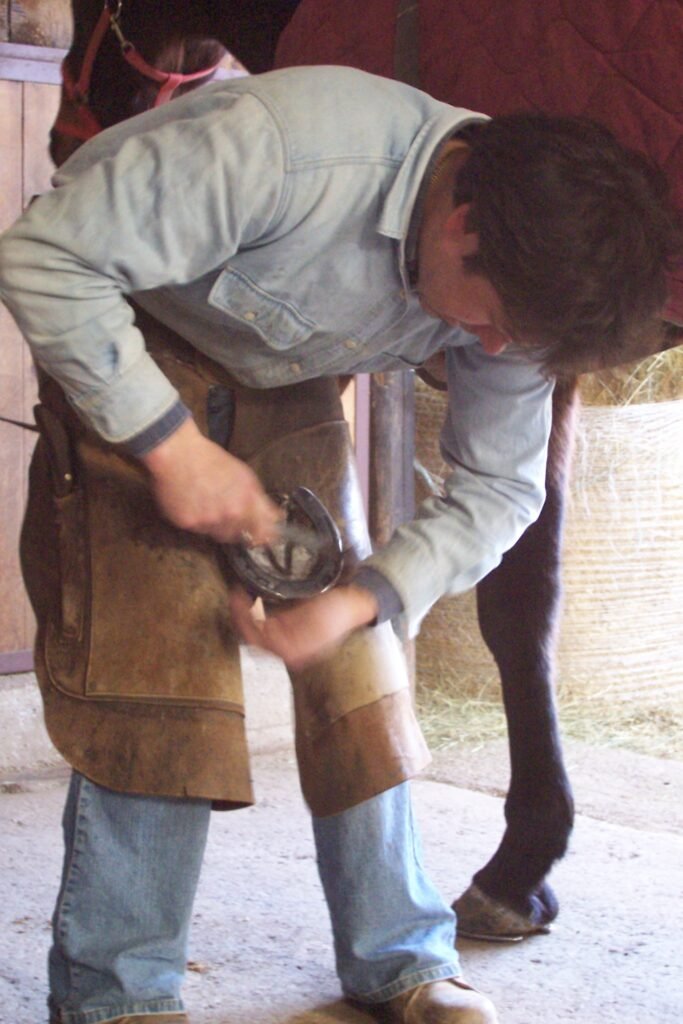
6. Farrier Maintenance Cycles: The Golden 4-to-6 Week Rule
The single most common contributor to chronic lameness, navicular pain, and suspensory ligament desmitis is an over-extended farrier schedule.
       [ Fresh Trim: Perfect Hoof-Pastern Axis (HPA) Alignment ]
                                 |
              [ Weeks 1 to 4: Steady Downward & Forward Growth ]
                                 |
          [ Weeks 5+: Toe Grows Longer -> Heel Crushes Backward ]
                                 |
       [ High Lever Arm Torque on Coffin Joint & Deep Flexor Tendon ]
- The Trimming Window: Domestic horses should be trimmed or reset every 4 to 6 weeks in summer (when horn growth is rapid) and 6 to 8 weeks in winter.
- The Hoof-Pastern Axis (HPA): When viewed from the side, a straight imaginary line should run down the center of the pastern through the front of the hoof wall. If the toe is allowed to grow too long, the angle breaks backward (“low-heel, long-toe syndrome”), multiplying the mechanical tension on the deep digital flexor tendon (DDFT) by hundreds of pounds with every single stride.
7. Nutritional Building Blocks for Rock-Solid Hooves
You cannot paint strength onto a weak hoof from the outside with oils; you must feed the living germinal matrix of the coronary band from within.
- Biotin (Vitamin B7): Clinical veterinary trials prove that 20 mg daily of pharmaceutical-grade biotin significantly improves hoof wall growth rate, tensile strength, and reduces crumbling. However, because hooves grow slowly, you must maintain supplementation for a minimum of 6 to 9 months before the newly fortified horn reaches the ground.
- Zinc & Copper: Essential co-enzymes for keratinization. Ensure a balanced 3:1 or 4:1 zinc-to-copper ratio.
- Methionine & Lysine: Crucial sulfur amino acids that construct the rigid polypeptide cross-links that give keratin its physical toughness.
- Moisture Myth: Soaking brittle hooves in water buckets actually weakens them. The hoof horn absorbs water rapidly, causing the tubular cells to swell and shrink as they dry, expanding nail holes and creating crumbling edges. Rely on internal nutrition and dry footing.
Conclusion: Stewardship from the Ground Up
Every time you lift your horse’s hoof and slide the pick across the sole, you are performing an act of fundamental stewardship. That small, compact capsule of keratin supports a thousand-pound athlete through gallops, jumps, and quiet pasture walks.
By combining uncompromising daily cleaning, vigilant thrush prevention, balanced nutrition, and strict farrier schedules, you safeguard your horse’s comfort, soundness, and longevity from the ground up.

Equestrian Journalist & Equine Welfare Specialist
Sarah Mitchel brings over fifteen years of hands-on equine management, classical dressage training, and veterinary wellness reporting to Horse Silk. Dedicated to promoting ethical horsemanship, pedigree preservation, and science-backed care protocols.
📖 Recommended Equestrian Reading & Official References
Deepen your equine mastery with these related guides from Horse Silk and leading equestrian authorities:
- Horse Silk Guide: Equine Hoof Care & Soundness Handbook
- Horse Silk Guide: Complete Horse Nutrition Feeding Guide: Forage, Concentrates & Minerals
- Horse Silk Guide: The Shire Horse: Heavy Draft Power & Hoof Management
- Official Authority: American Farrier’s Association (AFA) Official Standards
- Official Authority: British Farriers and Blacksmiths Association (BFBA)
