

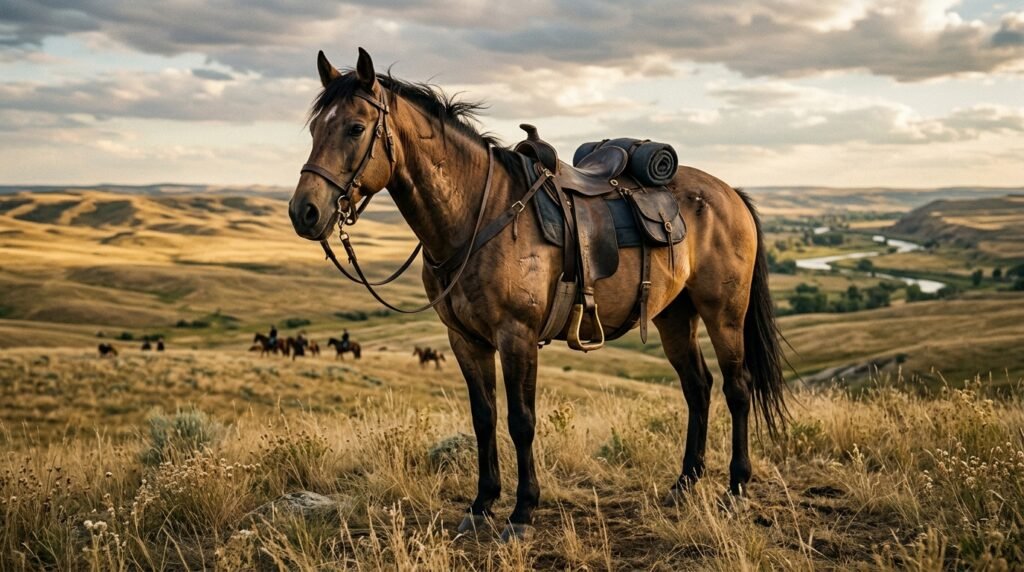
In the sweeping lore of American military and equestrian history, no horse has ever captured the collective heart of a nation like Comanche, the bay mustang gelding who became immortalized as the sole military survivor of the Battle of the Little Bighorn in June 1876. Revered for his indomitable spirit, rugged stamina, and stoic loyalty under fire, Comanche was elevated to the status of a living national treasure—an equine hero granted official full military honors and a lifetime retirement decree.
Origins of a Frontier Mustang: From Wild Plains to Army Mount
Born around 1862 on the open plains of the Oklahoma territory, Comanche carried the sturdy, compact frame of Spanish Mustang ancestry: approximately 15 hands high, possessing a broad forehead, deep chest, clean dense cannon bones, and a distinctive claybank bay coat with black points. Captured in a wild horse roundup in 1868, he was sold to the U.S. Army Quartermaster Corps in St. Louis for ninety dollars.
Assigned to the 7th U.S. Cavalry at Fort Leavenworth, Kansas, the gelding caught the discerning eye of Captain Myles Keogh, an experienced Irish-born soldier of fortune who had served in the Papal Army and the American Civil War. Keogh recognized in the mustang a calm, unflinching bravery under gunfire that thoroughbred mounts often lacked, purchasing him as his personal battle charger.
The Naming of a Legend: Battle of the Saline River (1868)
The gelding earned his famous moniker during a fierce skirmish along the Saline River in Kansas in September 1868. While carrying Captain Keogh into the fray, an arrow struck the horse deep in the right hindquarter. Rather than rearing, bucking, or bolting in terror, the horse merely grunted, held his footing, and unflinchingly carried Keogh through the engagement.
“He was struck by an arrow, but he didn’t flinch or cry out. He fought on like a true Comanche warrior.â€
— Captain Myles Keogh, 7th U.S. Cavalry
The Bloodstained Ridge: Little Bighorn (June 25, 1876)
On June 25, 1876, along the bluffs of the Little Bighorn River in Montana Territory, Lieutenant Colonel George Armstrong Custer and five companies of the 7th Cavalry—including Captain Keogh’s Company I—were surrounded and overwhelmed by allied Lakota, Northern Cheyenne, and Arapaho warriors. Every single soldier in Custer’s immediate battalion was killed.
Two days later, on June 27, when relief troops under Generals Alfred Terry and John Gibbon arrived at the catastrophic scene, they found complete devastation. Among the fallen soldiers on Keogh’s ridge stood a lone, grievously wounded horse, barely able to remain upright in the ravines. It was Comanche. He had sustained seven severe bullet wounds, his legs were slashed, and his body was weak from profound blood loss and shock.
The Miracle of Recovery: Farrier Korn and General Order No. 7
Tenderly transported by military steamboat Far West down the Yellowstone and Missouri rivers to Fort Lincoln, Dakota Territory, Comanche was placed under the round-the-clock care of the regiment’s chief farrier, John Korn. Suspended in a custom leather canvas sling for nearly a year to take weight off his shattered limbs, Comanche made an astonishing clinical recovery.
In recognition of his unprecedented valor and endurance, Colonel Samuel D. Sturgis issued the legendary General Orders No. 7 on April 10, 1878:
- Comanche was retired from all active military service with full honors.
- No person was ever permitted to ride or put a pack upon his back again under any circumstances.
- He was given freedom of the entire military post, roaming barracks and parade grounds at will.
- At all formal regimental parades, Comanche was to be draped in mourning gear, led by a mounted trooper, with stirrups reversed in honor of Captain Keogh.
Immortal Rest: The Legacy of Comanche
Comanche lived out a peaceful, pampered retirement for another thirteen years, beloved by soldiers and frontier children who fed him sugar lumps and apples. He passed away peacefully of old age on November 7, 1891, at the venerable equine age of 29. He was accorded full military honors—a distinction granted to only two horses in American history.
Today, Comanche’s preserved mount stands in a state-of-the-art climate-controlled pavilion at the University of Kansas Natural History Museum in Lawrence, Kansas. He remains an enduring, poignant monument to the unyielding courage, devotion, and sacrificial bond between soldier and horse.
🐎 Recommended Equine Reading & Official Resources
Continue exploring our breed and health archives: discover the The American Mustang Wild Spirit Guide and master our veterinary-approved Horse Colic Prevention & Emergency Protocol.
For verified international breed registrations and equestrian standards, consult the official Smithsonian Institution Equine Historical Archives.

1 thought on “Comanche: The Indomitable War Horse Who Survived the Little Bighorn”