The Legend of Eclipse 1: The Untamed Stallion Who Sired the Modern Thoroughbred
Reco Bithom
November 04, 20261 comment
Table of Contents The Legend of Eclipse
In the vast annals of sporting history, very few athletes across any species achieve an aura of absolute invincibility. In the eighteenth century, long before modern veterinary exercise physiology, biometric gait sensors, or aerodynamic racing silks, a singular chestnut colt redefined the physical boundaries of the equine species. His name was Eclipse, born during the Great Solar Eclipse of April 1, 1764, in the royal paddocks of Cranbourne Lodge in Windsor Great Park.
Eclipse would go on to compile an immaculate, untarnished racing record of 18 victories in 18 starts, capturing 11 prestigious King’s Plates across Great Britain. He was never once struck with a whip, never felt the sting of a spur, and routinely distanced his rivals by hundreds of yards. His dominance coined the immortal phrase that resonates across the sporting lexicon to this day: “Eclipse first, and the rest nowhere.” More profoundly, geneticists estimate that upwards of 95 percent of all modern Thoroughbred racehorses alive today trace their direct paternal lineage back to this singular, thunderous stallion.
The Celestial Foaling of 1764 The Legend of Eclipse
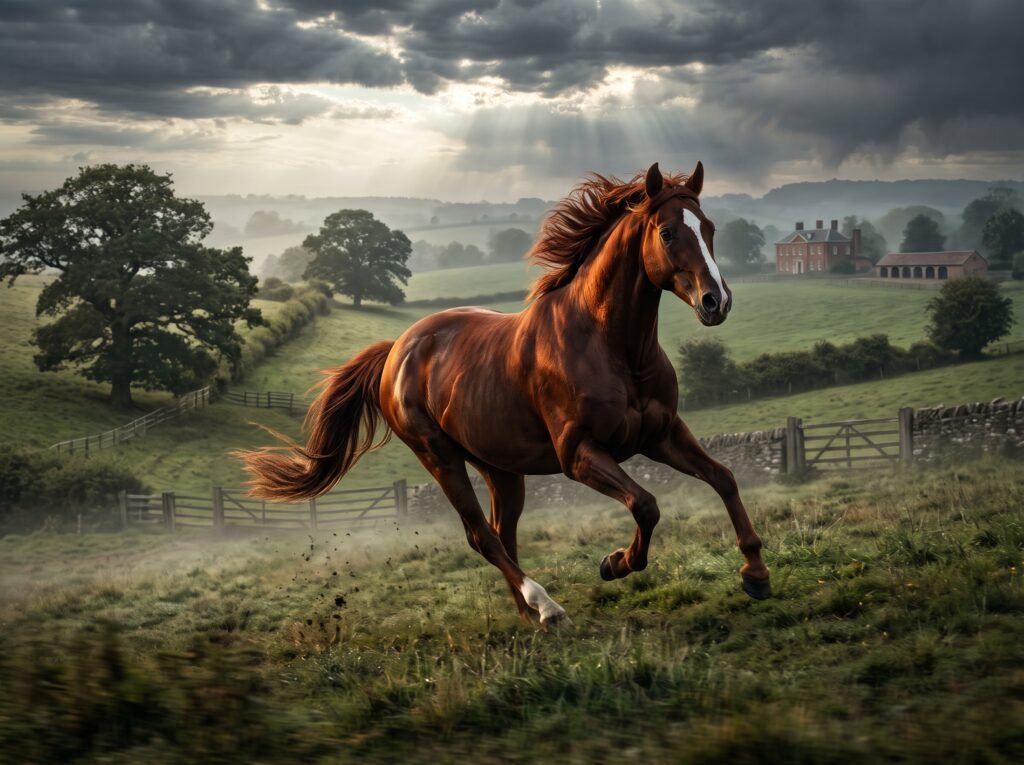
Foaled by Prince William Augustus, Duke of Cumberland, the colt was sired by Marske out of the celebrated broodmare Spilletta. At the exact hour of his birth, a total solar eclipse cast an eerie midday darkness across the British countryside. Recognizing the celestial portent, the Duke christened the newborn colt Eclipse. Despite his aristocratic royal heritage, Eclipse was not immediately hailed as a prodigy; in his early youth, he was tempestuous, fiercely independent, and possessed a wild, untamed fury that terrified ordinary stable lads.
Following the Duke’s death in 1765, the yearling was sold at auction for a modest sum of 75 guineas to William Wildman, a London sheep salesman and shrewd equine judge. Wildman recognized that beneath the colt’s fierce temperament lay an explosive physical apparatus: an extraordinarily deep chest cavity, long sloping shoulders, and hindquarters that coiled like tempered steel springs.
The Racing Career: “Eclipse First, and the Rest Nowhere”
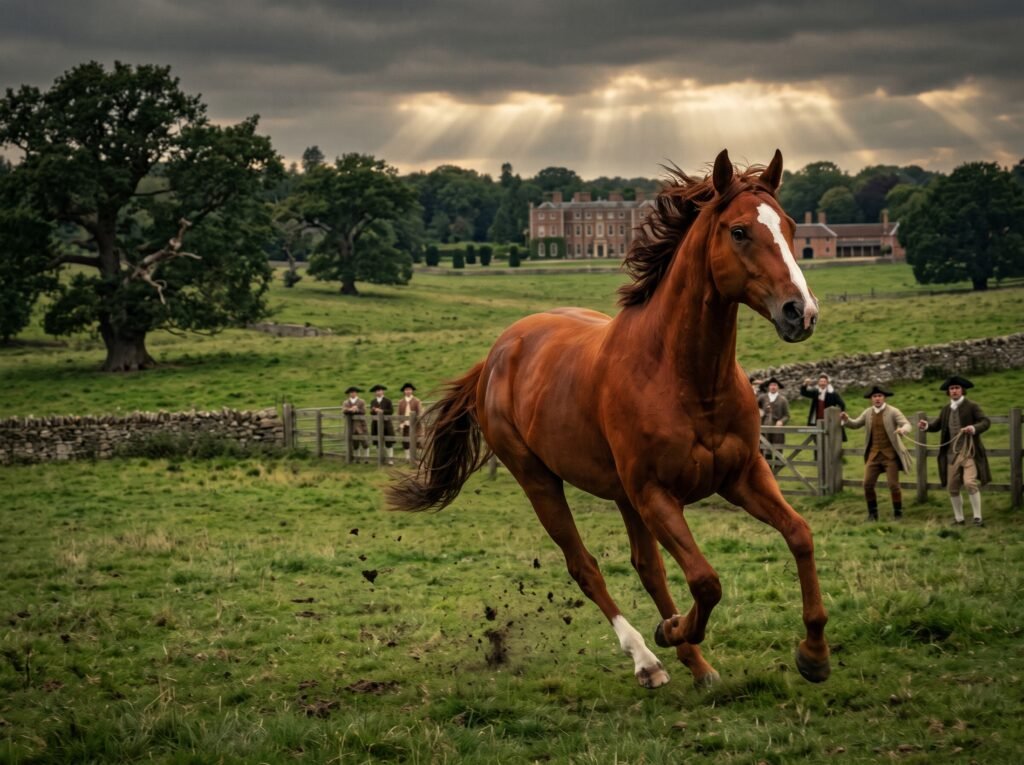
Eclipse did not make his official racing debut until the mature age of five—a stark contrast to the modern era of precocious two-year-old sprints. On May 3, 1769, at Epsom Downs, he lined up for the Noblemen and Gentlemen’s Plate, a grueling contest of four-mile heats. It was here that Dennis O’Kelly, an eccentric Irish adventurer and gambler, purchased a half-share in the stallion. Before the second heat, O’Kelly placed legendary wagers across the betting ring, uttering his famous prophecy:
“Eclipse first, and the rest nowhere!â€
— Dennis O’Kelly, Epsom Downs, 1769
Under the racing rules of the eighteenth century, any horse finishing more than 240 yards behind the winner was officially ruled “distanced” and eliminated from the records as having finished “nowhere.” Eclipse obliterated the field, crossing the post hundreds of yards ahead while his jockey John Oakley barely held a snug rein. Every rival was distanced, fulfilling O’Kelly’s audacious claim to the letter.
Anatomy of an Inhuman Stride: The Necropsy of 1789
When Eclipse passed away from an acute colic impaction on February 28, 1789, at the age of 24, Dennis O’Kelly commissioned the preeminent veterinary anatomist of the era, Charles Vial de Sainbel, to conduct a comprehensive scientific necropsy. The findings stunned eighteenth-century medicine and laid the foundational cornerstone for modern equine biomechanics:
An Enormous Cardiovascular Engine: Eclipse’s heart weighed an unprecedented 14 pounds (6.35 kg)—nearly 40 percent larger than the heart of an average Thoroughbred of his era. This massive cardiac volume allowed for astronomical stroke volume and maximum oxygen transport during sustained anaerobic gallop.
Extraordinary Stride Mechanics: Sainbel’s precise skeletal measurements revealed an enormous pelvic angle and femur length that generated an estimated stride length of 25 feet (7.62 meters) without losing kinetic balance.
Respiratory Efficiency: His trachea and windpipe diameter were unusually broad, providing minimal airway resistance even when operating at speeds estimated above 35 miles per hour over distances up to four miles.
The Genetic Legacy: The Sire of the Modern Thoroughbred The Legend of Eclipse
Retired to stud in 1771, Eclipse went on to sire 344 documented winners who captured dozens of classic races, including three Epsom Derby champions (Young Eclipse, Saltram, and Serjeant). Through his three dominant stallion sons—Potoooooooo (Pot-8-Os), King Fergus, and Joe Andrews—Eclipse’s genetic imprint cascaded down the centuries.
Modern mitochondrial and Y-chromosome sequencing conducted by the Royal Veterinary College confirmed what turf historians long proclaimed: more than 95% of living Thoroughbreds worldwide, including Secretariat, Northern Dancer, Man o’ War, American Pharoah, and Frankel, carry the Y-chromosome lineage of Eclipse. He was not merely a racing champion; he was the biological architect of the modern thoroughbred breed.
The Jockey Club – Thoroughbred registration, pedigree information, and industry resources.



1 thought on “The Legend of Eclipse 1: The Untamed Stallion Who Sired the Modern Thoroughbred”